The 30-Second Self-Defense Check: 5 Situational Awareness Habits That Keep You Off the News
July 29, 2026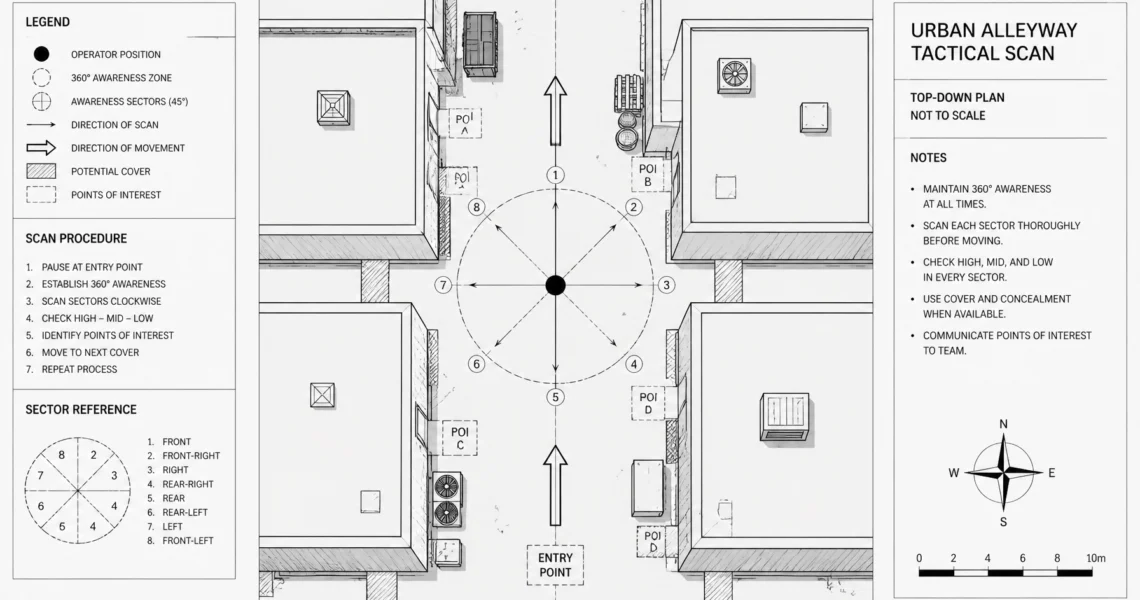
Ever wonder why most people walk around like blindfolded targets waiting for lightning to strike?
Let's get straight to the point: violence doesn't happen in a vacuum. Long before a fist is thrown or a blade is cleared from a waistband, a sequence of behavioral markers unfolds. These are pre-assault indicators, and ignoring them is a luxury you can't afford. Through our musings here at Educated Savages, we preach one core reality: street-fight defense training starts long before physical contact. If you rely solely on ground fighting or striking once the chaos erupts, you've already lost half the battle.
Here are five situational awareness habits that take less than thirty seconds to execute but keep you off the evening news.
1. Stop Staring at Your Phone in Transitional Spaces
You know exactly what a transitional space is: parking garages, subway turnstiles, building lobbies, and dark sidewalks where you transition from a secure environment to the public wild. Yet, what do ninety percent of people do? Head down, glowing screen illuminating their face, earbuds blasting music at maximum volume.
That is an open invitation for opportunistic predators.
When you lock your vision onto a smartphone screen, you forfeit your peripheral vision, your auditory cues, and your cognitive processing speed. If you need to check a map or fire off a text, stop entirely, press your back against a solid wall with your eyes up, handle your business, and then move. Never text and walk through choke points. Check out our fighting tips videos for a deeper breakdown on how sensory deprivation gets people ambushed.

2. Execute the 30-Second Threshold Scan
Entering a new room, restaurant, or convenience store without scanning is rookie behavior. The moment you cross any physical threshold, pause for five to ten seconds. Let your eyes sweep the room systematically.
Ask yourself three hard questions:
- Where are the primary exits and secondary egress points?
- Who in this room exhibits nervous or agitated body language?
- What objects or architectural barriers could provide immediate cover or concealment?
This isn't about paranoia; it's about basic survival mathematics. If shit goes sideways, the person who mapped the room in the first three seconds is already heading for the door while everyone else is freezing like deer in headlights.
3. Master Ruthless Positioning
Where you stand or sit in public dictates whether you control the engagement or get cornered like an animal. Avoid sitting with your back wide open to a chaotic room. Whenever humanly possible, position yourself with your back to a solid wall and a clear line of sight to all entrances.

In our self defense classes, we emphasize that tactical positioning beats raw athleticism every single time. If you’re at a bar, a coffee shop, or a transit stop, do not let people box you into booths or dead-ends. Keep your perimeter open. If someone drifts into your immediate bubble uninvited, pivot your hips, create distance, and establish verbal boundaries immediately.
4. Read the Red Flags: Spotting Pre-Assault Indicators
Assailants rarely attack completely out of nowhere; they leak their intentions through distinct physical tells. If you know what to look for, their body language screams their plans before they move an inch.
Watch for these cluster indicators:
- The Hands: Are they hidden in pockets, repeatedly clutching a waistband, or balling into tight fists? Weapon concealment and striking preparation almost always manifest in hand positioning.
- The Scan: Is a person looking around frantically: not at the scenery, but checking for witnesses, security cameras, or police presence before locking their eyes back onto you?
- The Posture Shift: A sudden squaring of shoulders, puffed-up chest, or aggressive pacing that invades your personal space.
When these indicators cluster together, your gut instinct will fire off alarm bells. Do not second-guess that discomfort to be polite. Trust your internal radar, create immediate distance, and remove yourself from the variable.

5. Run Mental "What-If" Scenarios
Survival is a cognitive reflex. If you have never mentally processed how you would react to a sudden threat, your brain will lock up under adrenaline shock. Elite operators and fighters constantly run micro-simulations in their heads.
While walking to your car in an empty parking deck, mentally rehearse: If someone steps out from behind that pillar right now, what is my immediate escape vector? What improvised tool or heavy object can I use as a barrier?
By running these low-pressure mental repetitions daily, you program your nervous system. When reality tests you, your brain doesn't have to panic and invent a solution from scratch: it simply executes the drill you've already run a hundred times in your head.
Zero Theory, Zero Filters
Situational awareness isn't some mystical sixth sense; it's a disciplined habit built on paying attention to a world that desperately wants you distracted. Real survival training isn't about looking pretty on mats or collecting belts; it's about keeping your head on a swivel so you never have to test your striking skills on cold pavement.
To explore our philosophy further, check out our core philosophy or gear up for your next training session by visiting our shop. Stop scrolling, start paying attention, and keep yourself off the news.
