How Many Repetitions Until It Saves You? The Real Math of Muscle Memory
September 4, 2026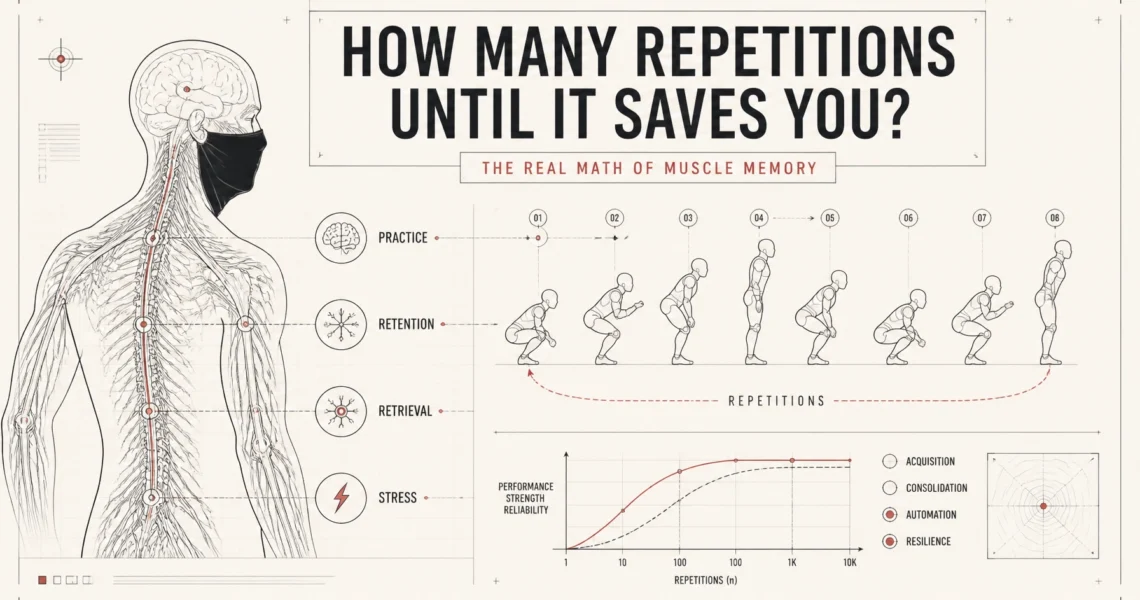
Musings
How many times do you need to repeat a self-defense movement before your body can find it when your brain is busy trying not to panic?
The honest answer is not 10,000. It is not “one class.” It is not whatever number a guy on social media pulled out of his ass.
There is no universal repetition count that guarantees survival. Motor learning depends on the movement, the person, the quality of practice, the time between sessions, and whether the skill has been tested outside a calm, cooperative drill.
But there are useful benchmarks.
For a simple, gross-motor response, you may understand the mechanics in a few dozen repetitions, perform it reasonably well after a few hundred, and begin building reliable retrieval after several hundred more distributed across days and weeks.
That is the difference between knowing a technique and having something available when the situation goes sideways.
Muscle memory is not stored in your muscles
“Muscle memory” is a convenient phrase, but your muscles are not keeping a secret notebook.
What changes is your nervous system. Through practice, the brain becomes better at organizing a movement, predicting the required force, coordinating the body, and retrieving the pattern with less conscious effort. This is the foundation of motor learning.
Most skills move through three broad stages:
- Cognitive: You think through every step.
- Associative: The movement becomes smoother and errors decrease.
- Autonomous: You can perform it with much less conscious attention.
A beginner may need to remember where the feet go, what the hands do, and what comes next. A trained person can respond to a cue without running the entire instruction manual in their head.
That matters because a violent encounter consumes attention fast. Noise, fear, pain, surprise, tunnel vision, and rapid decision-making compete for the same limited mental bandwidth.
If your response requires remembering seven steps in perfect order, it may disappear when you need it most.
Learning a technique is not the same as using it under adrenaline
You can perform a movement perfectly during a slow demonstration and still fail to retrieve it under pressure.
That is not hypocrisy. It is normal motor learning.
A calm drill gives you:
- A predictable partner
- A known starting position
- A clean environment
- No real consequence for hesitation
- Plenty of time to think
A real confrontation gives you none of that.
This is why self-defense classes should not stop at technical explanation. The technique must move from the cognitive stage into the associative and, eventually, more automatic stages. It must also be practiced in conditions that are unpredictable enough to challenge retrieval without turning training into reckless chaos.
The goal is not to create a movie-perfect reaction. The goal is to build a small number of practical responses that remain accessible when your heart is hammering and your attention narrows.
Research on motor learning consistently points toward a combination of repetition, feedback, consolidation, and varied practice. Repeating a movement builds the default pattern. Changing the conditions teaches the nervous system that the pattern still works when the angle, distance, clothing, partner, or timing changes. Rest and sleep help consolidate what was trained.
In plain English: drill it correctly, leave the gym, sleep, come back, and prove you can still do it.

The repetition ranges that actually make sense
There is no scientifically guaranteed number for “ready.” Anyone promising one is selling certainty, not training.
Still, the following ranges are useful coaching benchmarks for simple, high-percentage CQC techniques and defensive responses:
| Training stage | Approximate quality repetitions | What it usually means |
|---|---|---|
| Recognition | 25–50 | You understand the movement and can copy it slowly |
| Basic consistency | 100–300 | You can perform it with fewer pauses in a calm setting |
| Reliable mechanics | 300–500 | The pattern is becoming familiar and less dependent on conscious thought |
| Early retention | 500–1,000 | You have trained it across multiple sessions and can retrieve it after a delay |
| Pressure-tested skill | 1,000+ | You have added resistance, variation, fatigue, surprise, and realistic decision-making |
These are not magic thresholds. Five hundred sloppy repetitions can build five hundred sloppy repetitions. One hundred well-coached, purposeful repetitions may teach more than a thousand rushed ones.
The count also needs to be distributed. Cramming 600 repetitions into one afternoon can produce temporary fluency, but it does not prove retention. A better approach is to train the movement repeatedly over several weeks, then test it after a day, a week, and longer gaps.
If it vanishes after a short break, it was performance, not durable learning.
Why complex sport techniques take much longer
A simple protective frame, step, cover, or disengagement pattern has fewer moving parts than a complex sport combination.
Sport techniques often require:
- Precise timing
- Fine adjustments to an opponent’s reactions
- Multiple grips or transitions
- Complex balance and weight shifts
- Exact positioning
- Several linked decisions
- Adaptation to a skilled, resisting opponent
That does not make sport training useless. Far from it. Boxing, wrestling, Brazilian Jiu-Jitsu, Muay Thai, and other disciplines build timing, conditioning, pressure tolerance, and live problem-solving.
But a complex technique may require thousands of repetitions before it becomes dependable against resistance. Even then, experienced athletes continue refining it for years. The more decisions and precision a movement demands, the more vulnerable it becomes to fatigue, stress, poor footing, awkward clothing, and surprise.
This is one reason practical self-defense should not be built around collecting endless techniques.
More options do not automatically create more capability. Sometimes they create hesitation.
Gross motor skills have an advantage under stress
High stress can interfere with attention, working memory, dexterity, and fine control. That does not mean every fine motor action becomes impossible. It means precision-dependent actions deserve a higher burden of proof.
Simple actions using large muscle groups are generally easier to preserve:
- Covering the head
- Stepping off the line
- Framing with the forearms
- Pushing to create separation
- Turning the body
- Moving toward an exit
- Using the legs, hips, shoulders, and trunk together
This is where effective hand to hand combat training earns its place. The focus should be on movements that can be performed with imperfect information and reduced precision, not techniques that only work when every finger, grip, and angle lines up.
That does not mean “just get aggressive.” It means selecting movements that have a reasonable chance of surviving the conditions you are preparing for.
And the end state is not domination. In self-defense, victory means creating a window of opportunity to disengage and escape.

Why we drill fewer things harder
At Educated Savages, we use a Zero Theory, Zero Filters approach. That does not mean zero instruction. It means we remove the fantasy and keep asking a blunt question:
Can this be performed when the person is tired, startled, resisting, and scared?
If the answer is no, the technique does not belong at the center of a practical system.
We would rather build a smaller library of dependable responses than give students fifty techniques they can explain but cannot retrieve. Our training combines striking, grappling, ground survival, situational awareness, and CQC techniques, but the emphasis is on functional principles and repeatable movement.
The process usually looks like this:
-
Learn the basic pattern.
Understand the posture, direction, balance, and purpose. -
Repeat it cleanly.
Build the movement without rushing or adding unnecessary complexity. -
Add controlled resistance.
The partner stops being a mannequin. The movement must produce a result against pressure. -
Change the conditions.
Vary distance, angle, clothing, stance, speed, and starting position. -
Add mild stress.
Use time pressure, fatigue, noise, verbal distraction, and surprise in controlled doses. -
Test retention.
Return to the skill after a delay. If it only works on the day it was taught, keep training.

The stress piece comes last, not because pressure is unimportant, but because pressure cannot fix a bad movement. First build a usable pattern. Then challenge its retrieval.
So, how long until you can actually defend yourself?
A beginner can learn useful defensive habits during the first class. You can immediately start improving awareness, posture, movement, verbal boundaries, and the ability to create distance.
That is not the same as being fully prepared for every threat.
With consistent training, many people begin to feel noticeably more coordinated and confident within several weeks. After a few months of regular practice, they may have a small number of basic responses that are more familiar, more physically capable, and easier to retrieve.
But confidence should be tied to evidence:
- Can you perform the movement after time away?
- Can you use it against resistance?
- Can you make a decision instead of freezing?
- Can you perform it while tired?
- Can you adapt when the partner changes the angle?
- Can you create space and leave?
If the answer is only “yes, when my instructor counts the steps,” you are still learning. That is fine. Just do not confuse familiarity with readiness.
Armed encounters demand an even higher level of caution. Compliance, de-escalation, escape, and calling law enforcement come first whenever possible. Do not gamble your life over property or pride. Disarming a weapon is an extreme last resort, not a trick to attempt because you watched a demonstration.
If you or your family face an immediate threat of death or serious harm and no safe escape or compliance option exists, your response must come from trained muscle memory: not from trying to remember a complicated sequence. Even then, the objective is to create a window to disengage and escape.
That is the standard.
Train what you can retrieve
Muscle memory is built through quality repetition, but it is proven through retention and pressure.
Learn fewer things. Drill them correctly. Spread the work across time. Add variation. Test the response when conditions are less comfortable. Keep the movements simple enough to survive a nervous system under load.
That is the real math.
Your first class at Educated Savages is free. Join our Miami self-defense classes on Monday, Wednesday, or Friday and start building skills that have to work beyond the clean, comfortable version of the drill.