Fighting Back When Your Kids Are With You: Protecting a Family in Public
October 10, 2026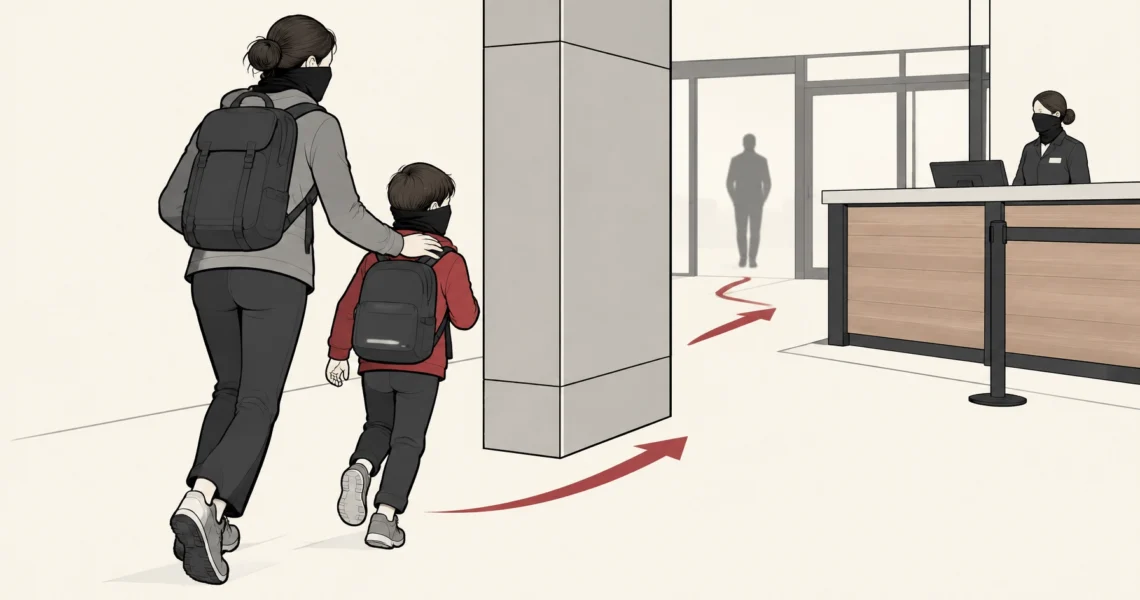
What do you do when trouble starts and your child is right beside you?
The usual self-defense advice assumes two free hands, room to move, and only yourself to worry about. Parents often have none of those things. A child may be in your arms, strapped into a stroller, frozen in place, or holding the hand you cannot let go of.
That changes the whole problem.
Your job is to get your child out
You cannot fight effectively while holding a small child. Trying to shield your child with your body while also engaging a threat can leave both of you exposed. Decide your priority before the moment gets messy:
Put distance and a barrier between your child and the threat. Create an opening to move. Disengage and escape.
Your child getting away is the win. Not proving a point. Not teaching someone a lesson. Not standing your ground because you’re angry or embarrassed.
When you’re the parent, a physical response is almost never the best option. Escalating an ego dispute while holding a toddler puts that toddler in harm’s way. No apology, no prize, no medal: walk away.
Someone cuts you off. Someone mouths off. Someone bumps the stroller, makes a rude comment, gives you a bad look, or starts a queue dispute. Walk away. Every time.
That isn’t weakness. It’s choosing your child over your pride.

Know when the threat is about your child
There’s a difference between an insult and an immediate threat. Don’t confuse the two.
Pay attention if someone reaches for your child, blocks their path out, follows you both after you’ve tried to leave, grabs the stroller or car seat, tries to force you toward a more isolated place, or launches an active attack. At that point, the goal is to get your child and yourself to safety, not to stay and fight.
Use your body as a barrier, not as an excuse to engage. Put yourself between the threat and your child if you can, then move toward people, staff, bright public areas, or an exit. Use a counter, a parked car, a table, a locked door, or another solid obstacle to create space.
Be loud and specific. “Back up!” “Call security!” “You in the blue shirt, call 911!” Direct words help your child understand what to do and give bystanders a clear job.
If you need to move quickly, take your child by the hand or, if appropriate, by the back of their clothing. Use simple commands they already know: “Come with me.” “Run to the counter.” “Stay beside me.” A child who is scared may not process a long explanation.
For more on recognizing trouble early and choosing safer routes, read our guide to situational awareness in public.
Make the family plan before you need it
A plan doesn’t have to be complicated. It has to be familiar enough that people can use it under stress.
For younger children, choose a few short commands and practice them calmly. “Hold my hand.” “Come to me.” “Go to the counter and stay there.” Use the same words each time. Agree on a code word that means a plan has changed or that your child should come to you immediately. Explain that the word is private and should not be shared casually.
For older children, choose a meeting point in places you visit often: a staffed counter, security desk, or clearly identified entrance. Tell them what to do if you become separated: stay in a public place and ask a uniformed officer or venue employee for help. Don’t have them wander around looking for you.
Older children should know to get help, not intervene. A teenager should never step between a parent and an attacker. Their job is to get to a staffed adult, call for help if they can, and follow the family plan. Our self-defense guide for teens covers age-appropriate training and decision-making.
If a child is old enough, agree on whose phone to call and what to say. Keep it simple: their name, where they are, and who they’re with. Practice meeting-point and separation plans in a calm, low-pressure way. The aim is readiness, not fear.
Sometimes you have to let go
This is one of the hardest things a parent can hear: if you’re being grabbed while holding a child, holding on at all costs may make the danger worse. Depending on what’s happening, the safer choice may be to put the child behind you or place them in the care of a nearby trusted adult while you create a chance to escape.
There is no clean, universal answer for a moment like that. It depends on the child’s age, the threat, and what’s around you. But if you’re being dragged while holding a child, both of you may be pulled into a more dangerous situation.
The guilt can be brutal, even when the decision is made to protect them. That doesn’t mean you failed. It means you made a hard choice under pressure. Talk through the principle with your family, and practice age-appropriate escape and help-seeking plans, not a script for a nightmare scenario.

Treat the stroller and car as part of the plan
A stroller can provide a useful barrier, but it can also anchor you in place. Don’t let it become the thing that stops you from moving away. If you need to leave, leave the stroller and belongings behind.
The space between your car and a building entrance is a bad place to get stuck in a confrontation. Before you load up, notice who and what is around you. Keep your keys accessible, get the children in, lock the doors, and leave when it’s safe to do so. Don’t argue through an open window or get out to settle a parking-lot dispute.
If there’s a threat near the car, move toward people, staff, or a secure public place rather than forcing everyone into a tight space. A child in a car seat may take time to unbuckle. Don’t let bags or shopping take priority over getting your family away from danger.

Train for the problem you actually have
Parent-focused self defense training should start before contact: where your child is standing while you check out, which side of the sidewalk they’re on, where the exits and staffed areas are, and whether your attention is buried in your phone. In a parking lot, it means noticing the surroundings before you open the car door.
It should also include scenario work where one arm is occupied, movement is limited, or you need to give a child a clear command while getting toward an exit. The physical basics should be simple and practiced safely under qualified supervision. Complicated moves are a poor bet when you’re tired, stressed, and responsible for a child.
That’s the point of practical self defense: not learning to win a street fight, but rehearsing how to avoid one, create a chance to leave, and protect someone who depends on you. Good survival training, street fight defense training, CQC techniques, and hand to hand combat training should all serve that purpose. Your goal is to disengage and escape.
The same goes for martial arts for self defense and self defense classes: training should account for real constraints, not assume you have an empty space and two free hands. At Educated Savages, our reality-based self-defense training focuses on practical decisions and movement under pressure.
If a weapon is involved, prioritize compliance over property or pride. If you or your child face an immediate threat of death or serious harm, rely only on skills you have actually trained; don’t improvise. The objective remains a chance to disengage and escape.
After you’re safe
Contact emergency services if anyone is injured or in immediate danger. Follow local law and venue procedures, and remember that defending your child doesn’t remove you from the usual legal standards for using force. Once the immediate danger is over, don’t keep chasing or escalating. Get to safety, ask for medical help if needed, and be careful about making detailed statements before you’ve had a chance to settle and seek legal advice.
Your child saw what happened. Stay close, tell them plainly that they’re safe now, and let them talk without blame or pressure. Don’t demand that they be brave or replay every detail. What you do in the hours after matters, too.
For a short checklist on what to do once you’ve reached safety, read what to do in the 60 seconds after escape.
Your kid does not need you to be a hero. They need you to be the reason they got out.
Train for the moment you hope never comes. Your free first class is available Monday, Wednesday, or Friday at 7:00 PM in Downtown Miami. Ages 15 and up; all fitness levels welcome. Family and private sessions are available.