The 60 Seconds After Escape: What to Do Once You’re Already Safe
September 28, 2026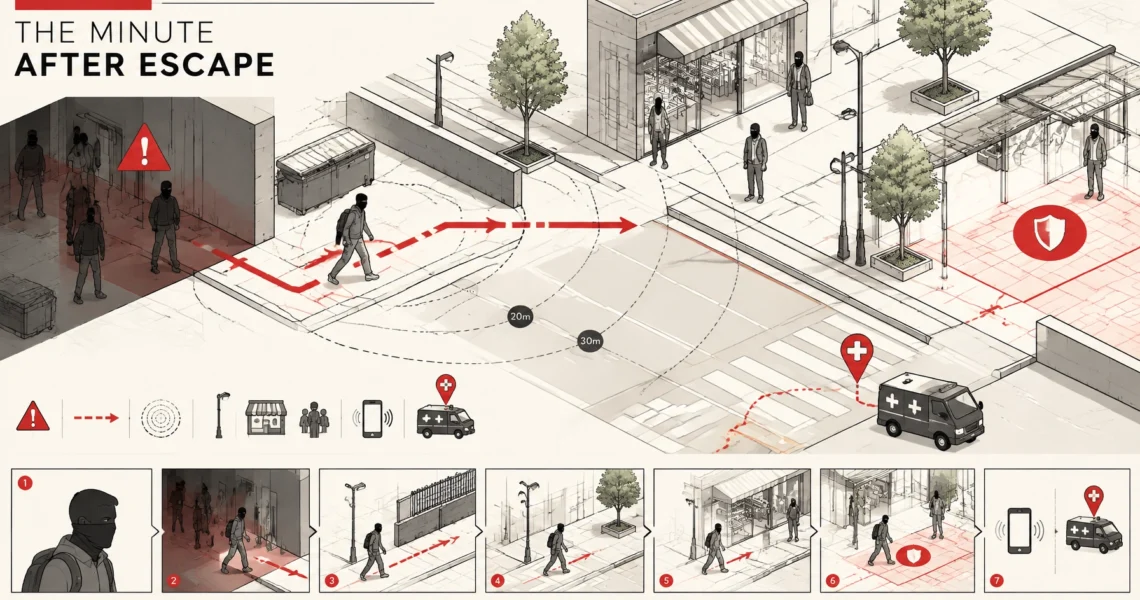
What do you do after you get away?
Not after the police arrive. Not after you tell your friends. The first sixty seconds.
You escaped the immediate threat, but the danger has not necessarily ended. It has changed shape. Your body is flooded with adrenaline. Your judgment is compromised. Your hands may be shaking while your brain insists you are fine.
That minute matters.
In practical self defense, victory is not beating someone. Victory is creating a window to disengage and escape. What you do next can protect that escape, or drag you straight back into danger.
Keep moving
Your first priority is distance and direction.
Keep moving away from the attacker. Put hard barriers between you and them: locked doors, cars, counters, fences, concrete walls, security desks, or other substantial structures. Change your direction and move toward people, light, open businesses, hotels, hospitals, police stations, or any place with staff and witnesses.
Do not stop in the middle of the street to look back and assess what happened.
You do not need a dramatic final scan. You need distance.
If you are running through an empty area, avoid staying on a predictable straight line if you can safely change your route. Move toward populated, visible spaces. Your objective is not to disappear into another isolated location. It is to become difficult to reach and easy for other people to see.
If you believe you are being followed, do not go home. Do not lead someone to your address. Do not walk to your car in a dark parking lot if another safe option exists. Go into a staffed business or public building and tell someone clearly that you were attacked and may be followed.
Your tactical situational awareness training should not end when the physical contact ends. Keep track of exits, barriers, people, and the person who created the threat.
If the attacker is still an active danger, keep your eyes on both the person and your exit. Do not turn your back on an active threat just because you have gained a few feet. Move toward safety while maintaining enough awareness to avoid being surprised again.
Your body is still in the fight
After a violent encounter, the sympathetic nervous system can remain fully activated.
Your heart rate is high. Blood is being redirected toward large muscle groups. Your breathing may be fast and shallow. Tunnel vision may be releasing slowly. Auditory exclusion, the muffled or distorted hearing that can happen under extreme stress, may fade in stages. Time may feel strangely slow or impossibly fast.
You may experience:
- Shaking hands or legs
- Numbness or tingling
- A racing heart
- Nausea
- Dry mouth
- Tunnel vision
- Ringing ears
- Confusion
- Time distortion
- An urge to stop and process what happened
That does not mean you are weak. It means your body made a survival response.
It also means you cannot fully trust the first thought that says, “I’m fine.”
Adrenaline can mask pain. A person may not immediately feel a cut, fracture, concussion, or puncture wound. Your brain is still prioritizing movement and survival, not a calm medical assessment.
Keep moving until you reach relative safety. Then slow down enough to check yourself.

Call from safety, not from panic
Once you reach a position of relative safety, call emergency services.
If there is an immediate danger or serious injury, call 911 or your local emergency number as soon as you can do so safely. Stay on the line and follow the dispatcher’s instructions.
Give four essential pieces of information:
- Where you are. Give the exact address or the clearest landmark you can identify.
- What happened. Say that you were attacked and describe whether the attacker had a weapon, is still nearby, or may be following you.
- Why you need help. State plainly that you were attacked and feared for your life if that is accurate.
- What you look like. Give a description of yourself (your clothing, height, and location) so responding officers do not mistake you for the suspect.
Keep your hands visible when officers arrive. Follow instructions. Understand that officers may not know who started the incident when they first reach the scene.
Be polite and cooperative, but do not try to deliver a perfect courtroom speech while your nervous system is still overloaded. Give the immediate facts. Point out injuries, witnesses, evidence, and the direction the attacker went.
Before giving a detailed statement, ask to speak with a lawyer. Self-defense laws vary by jurisdiction, and you may be physically and mentally compromised in the minutes after the event. This is general safety information, not legal advice.
Do not lie. Do not invent details. Do not guess at things you did not see. “I don’t know” is better than filling gaps with adrenaline-fueled speculation.
Do not narrate your escape online
Do not post about the incident.
Do not send a long message to the group chat. Do not upload video. Do not argue with the attacker online. Do not start explaining every decision you made while trying to survive.
Anything you say in the first minutes may become part of a report, investigation, insurance claim, or courtroom record. You may believe you are clarifying the situation, but you are often trying to reconstruct it while your memory is still being affected by stress.
Secure help first. Speak with appropriate professionals before discussing the specifics publicly.
Keep witnesses nearby
Look around without chasing anyone.
Notice who was present, where they were standing, whether anyone may have recorded the incident, and which businesses or buildings may have security cameras. If a witness is willing to stay, ask them calmly to remain until officers arrive.
Do not run after people who leave. Do not grab someone to force them to wait. Do not return toward the attacker because you think a witness is walking away.
Give responding officers the best description you can: clothing, approximate location, direction of travel, and whether the person appeared injured or armed.
Your job is to preserve information without creating another confrontation.

Check your body
When you are safely separated from the threat, perform a physical self-check.
Look at your hands. Check your head, neck, chest, abdomen, back, hips, and legs. Feel for blood, swelling, unusual pain, wetness, or damage to your clothing. Do not assume a wound would hurt immediately.
If you find heavy bleeding, difficulty breathing, severe pain, confusion, loss of consciousness, or any possible puncture wound, tell the dispatcher and request medical assistance.
Do not clean yourself up before receiving medical guidance if doing so could destroy evidence. Do not wash blood from clothing, throw away damaged items, or clean the scene. Let medical and law-enforcement professionals advise you.
Do not return to the scene.
Do not go back for your phone, wallet, keys, or anything else. Property can be replaced. Do not return to help the person who attacked you unless there is a genuine life-threatening medical emergency and it is safe to do so. Even then, call emergency services first and follow their instructions.
A useful rule from street fight defense training in Miami is simple: once the opening to escape appears, take it. Do not turn survival into a second engagement.
Then comes the crash
The adrenaline drop can arrive suddenly.
You may shake uncontrollably, feel cold, become nauseated, start crying, feel exhausted, or struggle to understand what people are saying. You may feel detached from your surroundings. You may even laugh or become angry without intending to.
That is normal physiology, not a character defect.
Sit somewhere safe. Sip water. Breathe slowly and steadily. Let a trusted person stay with you. Avoid alcohol and drugs. Do not drive long distances while disoriented or exhausted. Do not handle weapons. Do not make major decisions while your judgment is still compromised.
If the incident involved an armed attacker, remember the hierarchy: comply first when the attacker is demanding property and compliance remains safe. If compliance stops being safe and you or your family face an immediate threat of death or serious harm, trained muscle memory may be needed to create an opening. The objective remains the same: disengage, escape, and survive. Our armed intruder decision framework explains that distinction in detail.
The days after are part of survival
The event may keep running after your body leaves the scene.
You may have trouble sleeping, replay the encounter, avoid the location, scan every stranger, snap at people, or feel unsafe in ordinary places. You may become unusually jumpy or emotionally numb.
Some short-term stress reactions are common after violence. They should not be ignored if they persist, intensify, or interfere with work, school, relationships, sleep, or basic daily life.
Speak with a licensed mental-health professional if you are struggling. Seek urgent help if you feel unable to stay safe, cannot function, or are thinking about harming yourself or someone else.
Survival training is not just learning what to do during contact. It includes recognizing the aftermath and getting the right support instead of pretending nothing happened.

The escape is only the beginning
The fight is not over simply because the attacker is behind you.
Surviving is a sequence:
- Recognize the opening.
- Create distance.
- Move toward people, light, and barriers.
- Call from relative safety.
- Identify yourself clearly.
- Preserve witnesses and evidence.
- Check for injuries.
- Do not return.
- Manage the crash.
- Get medical, legal, and psychological support.
That is the real point of reality-based self-defense training in Miami. Not ego. Not domination. Not collecting techniques you hope never to use.
The goal is to make sound decisions when your body is loud, your vision is narrow, and everything feels like chaos. That is what serious self defense training should prepare you to do.
The next sixty seconds are still part of the fight.
If you want to build practical skills under pressure, explore our self-defense classes in Miami. Educated Savages trains civilians in practical self defense, survival training, street fight defense training, and CQC techniques with one clear standard: create the opportunity to get home safely.
Free first class: Monday, Wednesday, or Friday at 7:00 PM in Downtown Miami.
Zero Theory. Zero Filters.