The Myth of MMA: Why Combat Sports Are Preparing You for the Wrong Kind of Violence
August 29, 2026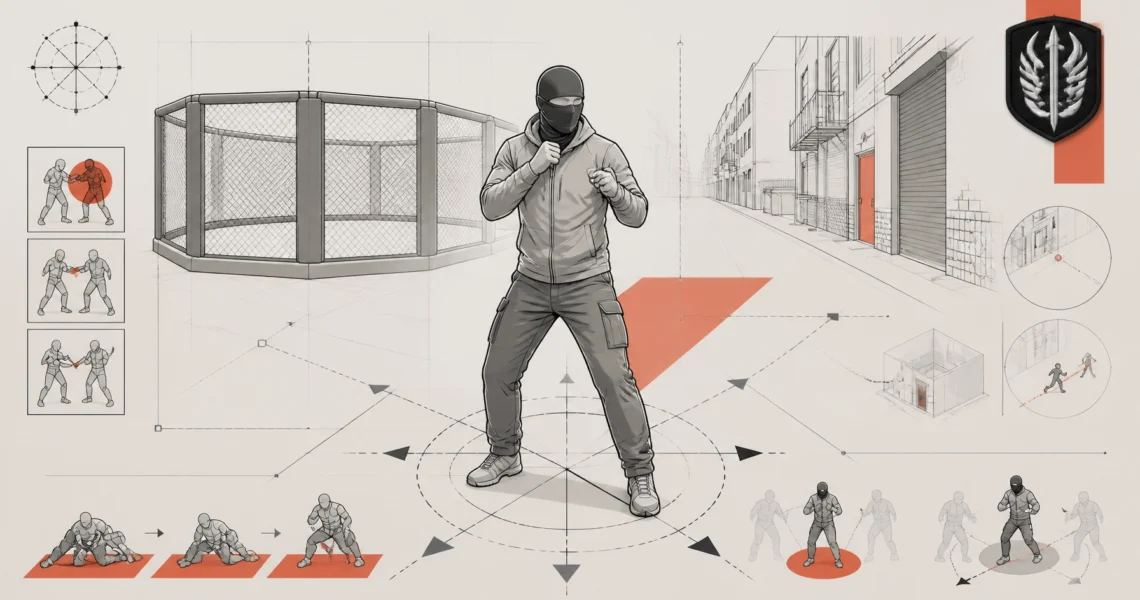
28 August 2026
Are you training to win a fight, or to survive the kind of violence that does not give a damn about rules?
For the past thirty years, martial arts subculture has championed a compelling archetype: the “Educated Savage.” The term describes an ideal individual, articulate, emotionally regulated, and civilized in everyday society, yet physically capable of dominating a confrontation when necessary.
It is a powerful idea. It is also incomplete.
When Brazilian Jiu-Jitsu (BJJ) revolutionized combat sports in 1993, it appeared to offer the definitive blueprint for this archetype. Master ground grappling, joint locks, and chokes through daily, high-intensity pressure testing, and you should be able to calmly control almost any violent threat.
The problem is not BJJ. The problem is confusing a sport’s pressure-tested skills with complete practical self-defense.
Sport violence is controlled, consensual, and structured. Criminal violence is often sudden, unfair, armed, and chaotic. That gap matters.
1. The Myth Born in 1993
The rise of modern combat sports as a self-defense meta began at UFC 1 in 1993. Royce Gracie, a 175-pound practitioner, submitted three larger opponents in one night using ground fighting.
That event transformed the martial arts market. Traditional systems were increasingly judged against combat sports, while BJJ became the new symbol of realism. The pitch was simple: grappling allowed practitioners to train at high intensity without taking the same repeated head impacts associated with striking sports such as boxing.
For millions of people, the UFC became proof that athletic combat performance was the same thing as real-world survival.
It is not.
The market shift
Over the following decades, traditional martial arts lost ground while BJJ expanded globally. The numbers often used in this discussion include:
- Karate enrollment declining by 61%.
- Taekwondo enrollment declining by 66%.
- BJJ enrollment increasing by 104%.
- More than 6 million BJJ practitioners worldwide.
Those numbers describe a major cultural shift. They do not, by themselves, prove that one system is better for every type of violence.
The dueling illusion
As the UFC evolved into a mainstream sport, its fight dynamics moved further away from street reality, not closer.
Early UFC events featured high submission rates. As fighters improved their takedown defense, striking, and positional awareness, submissions became less common. Modern MMA is now a complex game of standing strikes, distance management, takedown prevention, and cage control.
Yet many people still train on the ground as if combat were frozen in 1993.
A sport fighter is solving a specific problem: how to defeat one resisting opponent inside a defined ruleset. A civilian practicing practical combatives is solving a different problem: how to identify danger, create space, stay mobile, and escape without getting trapped in a prolonged fight.
Those are not the same job.
2. The 3 Data Blind Spots of Combat Sports
Sport combat optimizes for scenarios that represent only a narrow slice of real-world violence. Crime data and self-defense research point toward three recurring complications: the attacker may be known, weapons may be involved, and there may be more than one threat.
The following table presents the figures used in this analysis. Exact percentages vary by dataset, crime category, year, and definitions. The Bureau of Justice Statistics victim–offender relationship tables are useful for understanding those distinctions.
| Metric / Context | Statistical Reality |
|---|---|
| Relationship to attacker | 77%–78% acquaintances, family, or partners; 22%–24% total strangers |
| Weapon involvement | 73.7% of homicides involve firearms; 27.6% of aggravated assaults involve weapons |
| Multiple attackers | 48.7% of youth violent crime involves multiple people; 43% of sexual assaults involve multiple offenders |
These figures should not be treated as one universal national breakdown. They come from different forms of crime reporting and require context. The underlying point, however, remains serious: the square-up, one-on-one, unarmed fight is not the only problem civilians need to understand.
Gap 1: The stranger fallacy
Combat sports condition athletes to guard against a hostile stranger stepping forward to trade blows.
Real violence often develops through familiarity, coercion, boundary erosion, and manipulation. The person creating the danger may be a partner, former partner, colleague, acquaintance, or family member. The threat may begin with unwanted proximity, pressure, intimidation, or a refusal to accept “no.”
A sport class can teach you how to grapple. It may not teach you how to recognize the moment a normal interaction becomes unsafe.
That is why serious self-defense training must include verbal boundaries, positioning, decision-making, and early threat recognition: not just physical technique.
Gap 2: The unarmed assumption
Sporting events guarantee bare-handed combat inside a controlled environment.
Real-world violence may involve a firearm, knife, bottle, blunt object, vehicle, or another improvised weapon. A practitioner who commits to a prolonged ground exchange may become dangerously tied to one person while missing what is happening around them.
A triangle choke or armbar can be effective in the correct sporting context. It does not automatically solve the presence of a concealed weapon, a second attacker, concrete, or an escape route that is closing.
This is not an argument to ignore grappling. It is an argument to stop pretending that grappling alone covers the entire problem.
Gap 3: The 1v1 paradox
Combat sports enforce weight classes, single-opponent matches, referees, and boundaries.
Predatory violence does not.
When multiple attackers are present, going to the ground can leave you exposed to strikes from people you cannot see. It can also destroy your mobility and make escape harder. As the supplied analysis argues, only a minority of victims physically defeat multiple attackers, while escape is often the more realistic survival outcome.
The lesson is blunt: if your training only works when one opponent is attached to you, you may be practicing the wrong victory condition.
3. The Ground Strategy Trap

The claim that “90% of fights go to the ground” has been repeated for decades. It is also a poor foundation for self-defense programming.
Research and commentary on the original LAPD material suggest that the figure was built from a narrow set of police use-of-force and arrest situations: not all civilian fights. Some studies and observations show that many altercations involve a clinch, a fall, or contact with the ground. But there is no single reliable percentage for every type of fight.
The useful conclusion is not “ground fighting does not matter.”
The useful conclusion is this:
You should know how to survive the ground without building your entire self-defense strategy around staying there.
The ground is hard. It may be concrete, asphalt, broken glass, a curb, a staircase, or a busy roadway. It may also be surrounded by people you cannot track.
In sport grappling, the ground is an offensive strategy. You may choose to pull guard, work for position, hunt a submission, and win by points or tap-out.
In predatory violence, your objective is different. Protect your head. Create space. Regain your feet. Keep your surroundings visible. Leave.
The ground is a place you may end up: not necessarily where you should choose to remain.
4. Redefining the True “Educated Savage”
Physical combat training remains valuable. Regular, humbling sparring can improve timing, conditioning, composure, and self-control. Research on martial arts participation has also found associations with reduced hostility, improved psychological well-being, and stronger emotional regulation. A peer-reviewed review of martial arts and combat sports provides useful context.
The answer is not to abandon BJJ, MMA, wrestling, boxing, or other combat sports.
The answer is to place them inside a broader framework.

1. Awareness: risk detection and de-escalation
Before physical contact, there may be warning signs:
- Unwanted proximity.
- Target glances.
- Concealed hands.
- Aggressive questioning.
- Sudden changes in tone.
- Attempts to isolate or redirect you.
- Refusal to respect a clear boundary.
Awareness is not paranoia. It is a way to preserve time.
Programs such as Enhanced Assess, Acknowledge, Act (EAAA) have demonstrated that comprehensive resistance education can significantly reduce the risk of sexual assault among participants. The research emphasizes recognition, confidence, boundary setting, and action: not a magic technique. Review the EAAA randomized trial for the evidence.
2. Boundaries: verbal assertion and spatial control
A capable person does not need to prove capability in every argument.
Use your voice early. Set a direct boundary. Move toward people, light, exits, and witnesses. Avoid allowing someone to walk you into a corner or compress the distance without consequence.
This is where many combat sports programs are silent. They teach what to do after the fight begins, but not always how to stop a bad interaction from becoming a physical one.
3. Physicality: a savage repertoire and fast mobility
Physical training still matters. You need the ability to function when fear, fatigue, pain, and adrenaline hit.
But the physical layer should support survival, not ego. It should include:
- Striking and defensive movement.
- Clinch awareness.
- Takedown defense.
- Basic ground escapes.
- Weapon awareness.
- Multiple-attacker movement.
- Fast recovery to the feet.
- Simple actions that hold up under pressure.
This is the “savage” part: but it is controlled, purposeful, and restrained.
The emotional anchor
Combat skills should not make you eager to fight. They should make you less dependent on fighting.
A trained person understands how quickly violence becomes expensive, chaotic, and legally complicated. They do not need to chase every insult or accept every challenge. They can remain calm because they have experienced pressure before.
That is the real value of pressure testing.
It is not the confidence to dominate a stranger in a parking lot. It is the composure to recognize danger, avoid stupid decisions, and act decisively if escape disappears.
Escape is the only victory condition
In combat sports, victory means submission, points, or knockout.
For practical self-defense, victory means creating a window to disengage and escape.
That may require physical force. It may require a frame, a strike, a takedown defense, a ground escape, or a short burst of aggressive movement. But the purpose is not to stay and win a consensual duel.
The purpose is to get out.

5. The bridge between the cage and the street
Educated Savages is built around a blunt reality: combat sports train you in a perfect environment, and violence outside the gym does not.
In sport, you have rules, referees, padded mats, weight classes, one opponent, and a clean arena. You know when the exchange starts. You know when it stops. Even when the pace is brutal, the container is controlled.
Real-world violence is the opposite. No rules. No referee. Hard surfaces. Weapons. Multiple attackers. Blind angles. Sudden escalation. Dirty setups. Total unpredictability.
That does not make MMA useless. Far from it.
MMA and other combat sports produce real physical attributes that matter under pressure: timing, contact tolerance, conditioning, balance, pressure-tested striking, takedown defense, clinch work, and the ability to keep functioning when another human being is trying to impose chaos on you.
The mistake is not training those skills.
The mistake is treating those skills like the whole damn answer.
At Educated Savages, we deliberately bridge that gap. We keep the pressure-tested physicality that makes MMA valuable, then adapt it for the street by adding what the cage does not require:
- Awareness before contact.
- Verbal boundaries and spatial management.
- Weapon awareness.
- Multiple-attacker movement.
- Fast recovery to the feet.
- Decision-making under adrenal stress.
- Escape as the only victory condition.
That is the line we do not blur.
Respect what the cage teaches, but never confuse the cage with the street.
Conclusion
The martial arts industry built a massive global market by equating athletic combat performance with self-defense mastery.
Combat sports build resilience, fitness, timing, and tactical reflexes. Those benefits are real. BJJ and MMA can provide an excellent foundation.
But relying on them exclusively can leave critical gaps around awareness, boundaries, weapons, multiple attackers, hard surfaces, and legal consequences.
True self-defense does not mean dominating a consensual duel in a cage.
The genuine “Educated Savage” understands that physical capability is a last resort. Survival depends far more on recognizing danger early, enforcing boundaries, staying mobile, and having the wisdom to walk away when walking away is still possible.
At Educated Savages, our reality-based self-defense training is built around that distinction: zero theory, zero filters, and no fantasy that a sport ruleset automatically prepares you for the street.
Train hard.
Think clearly.
Do not get trapped in the wrong fight.