Getting Thrown to the Concrete: 4 Ground Fighting Survival Rules When You Can’t Get Up
July 29, 2026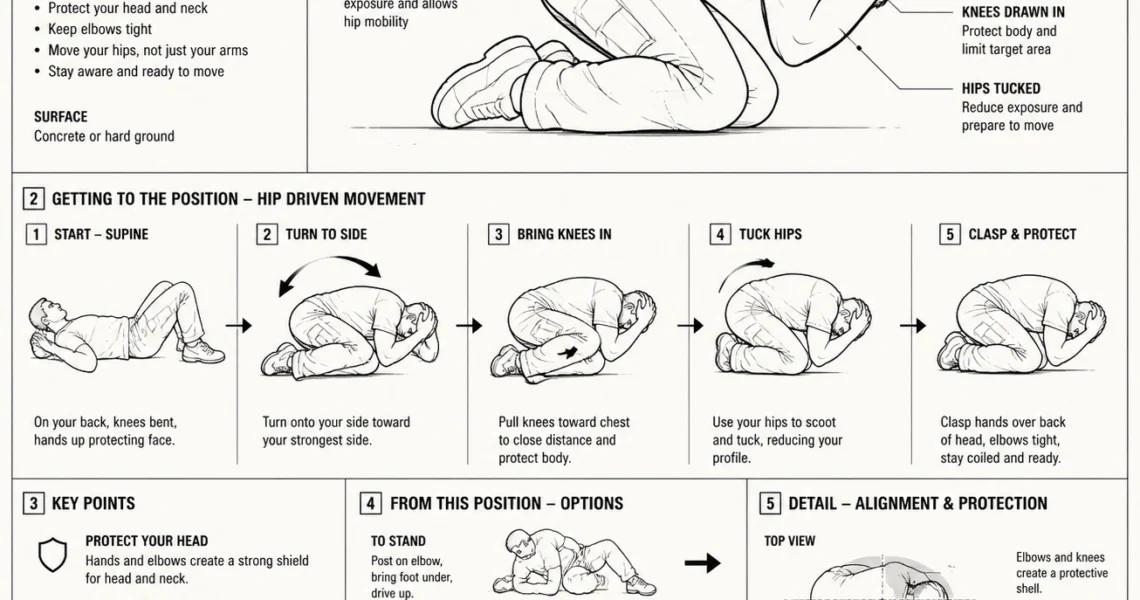
When it comes to tactical self defense miami, preparation is everything.
Ever wonder what happens when your pristine tournament guard meets unyielding asphalt instead of a padded training mat? Let’s be completely honest: most martial arts fantasies die the exact moment gravity takes over and your skull bounces off a concrete curb. When you are dragged to the pavement, the luxury of point systems, referee interventions, and soft tatami mats vanishes instantly. Mastering ground fighting survival isn’t about scoring a sweep or working toward an elegant submission; it is entirely about preserving your life, minimizing catastrophic trauma, and standing back up before secondary threats end the fight for you.
In a controlled academy setting, spending five minutes working from bottom open guard is standard practice. On the street, five seconds on the ground can lead to life-altering head trauma, extreme road rash, or a deadly kick from an unseen second attacker. When self-defense encounters degenerate to the pavement, you need an aggressive, realistic framework. Understanding the brutal realities of self-defense requires setting aside sport-bjj dogma and embracing tactics engineered specifically for violent encounters on hard surfaces.

The Brutal Reality of Pavement vs. Padded Mats
The primary difference between sport grappling and real-world violent conflict is the environment. Concrete does not absorb impact; it redirects every foot-pound of kinetic energy directly back into your bones and joints. A simple double-leg takedown that would yield two points on a competition mat can cause skull fractures, intracranial bleeding, or spinal trauma on asphalt.
Furthermore, street encounters rarely happen in a clean, open space. You are dealing with jagged rocks, broken glass, vehicle bumpers, curbs, and discarded needles. Laying your bare skin against these surfaces while trying to entangle an aggressive attacker’s legs is a recipe for severe injury. When considering Brazilian Jiu-Jitsu self-defense application, you must filter every technique through the reality of unforgiving terrain and unpredictable chaos.
4 Fundamental Rules for Ground Fighting Survival
When you find yourself taken down against your will, you must instantly activate a survival mindset. Here are the four non-negotiable rules for surviving a dangerous ground fight when you cannot immediately avoid going down.
1. Protect the Head and Spine Above All Else
Prioritizing head protection is the foundational rule of ground fighting survival. On the street, a single solid blow to the back of the head against concrete can cause loss of consciousness or lethal brain swelling. If you are thrown or tackled, your immediate reflex must be to tuck your chin to your chest, flex your neck, and create structural frames with your arms.
Never lay flat on your back with your head exposed. Maintain dynamic structural frames using your forearms and shoulders to shield your jaw and temple. If an attacker manages to post above you and rain down punches, close the distance to pin their posture or push them away violently to build a protective frame. Every millisecond your head remains unprotected on pavement increases the likelihood of a catastrophic knockout.
2. Disengage and Stand Up Immediately
The absolute objective of ground fighting survival on asphalt is returning to a standing position as fast as humanly possible. The bottom position on the ground is an inherent death trap in a real-world violent attack. You have zero mobility, limited visibility, and compromised leverage.
Avoid pulling guard, attempting high-risk inversions, or lingering in bottom control positions to set up complex submissions like triangle chokes or armbars unless they are immediately forced upon you. Instead, use explosive framing, hip escapes (shrimping), and the technical stand-up technique. Keep one hand framing against the opponent’s throat or chest while driving back up to your feet. Standing up restores your vision, mobility, and ability to escape the threat entirely.
3. Beware of Environmental Hazards and Multiple Attackers
Navigating environmental threats is crucial for ground fighting survival. In a street fight, you are rarely fighting in a vacuum. Street fights frequently involve multiple aggressors, even if you initially thought you were engaged with only one person. The moment you enter a ground engagement, you become completely vulnerable to soccer kicks, stomps, and blindside attacks from your opponent’s associates.
While on the ground, maintain 360-degree situational awareness as much as possible. Do not get tunnel vision on the person directly on top of you. Scan the periphery, keep moving your hips to avoid getting pinned against walls or curbs, and be conscious of concealed weapons like pocket knives or brass knuckles that an opponent can draw once combat stalls on the floor. For detailed tactical overviews on real-world conflict mechanics, consult established self-defense protocols.
4. Weaponize Brutal Simplicity and Gross Motor Skills
Under extreme physical stress, fine motor skills rapidly deteriorate. Complex sport-grappling techniques that require precise finger grips, intricate leg entanglements, or multi-step setups fail under high-stress conditions. Vicious efficiency becomes the primary metric of ground fighting survival.
Rely on coarse, high-percentage movements: heavy frames, explosive hip movements, eye gouges, throat strikes, biting, and groin disruptions if locked under a heavier opponent’s mount or side control. Use whatever leverage is available to break their base, disrupt their posture, and create an opening to disengage. Do not fight fair; fight to survive and break contact.
Adapting Martial Arts for Ground Fighting Survival
If you train in combat sports like BJJ, Judo, or Wrestling, you already possess a powerful toolkit. However, you must consciously adapt these arts to survive on the street. To train effectively for ground fighting survival, you must eliminate sport-specific habits that create dangerous vulnerabilities outside the academy.
- Ditch the Sport Guards: Avoid playing deep half-guard, spider guard, or berimbolo setups where your head and spine are exposed directly to the ground and open strikes.
- Prioritize Top Control: If you must go to the ground, ensure you end up on top. Top position allows you to strike, control the opponent’s hands, scan the area, and disengage at will.
- Develop Anti-Grappling Skills: Focus heavily on takedown defense, sprawling, wall walks, and quick posture restoration rather than bottom-game sweeps.
- Build Physical Resilience: Real-world escapes demand functional power, neck strength, and core stability. Integrating targeted tactical fitness conditioning into your routine builds the physical armor necessary to absorb impact and explode out of bad positions.
Practical Drills to Improve Ground Survival
To ensure your skills translate when adrenaline spikes, incorporate stress-testing into your ground fighting survival routine. Have a training partner put on boxing gloves while you wear a mouthguard, start from bottom mount on a hard mat surface, and practice escaping to a technical stand-up while they throw continuous light punches at your head. This drill quickly exposes holes in your framing and eliminates passive sport habits.
Another crucial drill involves simulated multi-attacker scenarios. Grapple with one training partner while a second partner stands nearby with a pad. At random intervals, the second partner advances to kick or stomp, forcing you to constantly scan, alter your positional angles, and prioritize instant standing disengages over floor control.
Final Thoughts on Surviving Ground Conflicts
The ground is the absolute last place you want to be during an unprovoked physical assault. Concrete offers no forgiveness, and the unpredictable nature of street violence means staying down puts your life in extreme jeopardy. Remember that true ground fighting survival ends the moment you can create enough separation to sprint to safety. Train hard, strip away sport-centric illusions, prioritize head protection and mobility, and always make standing back up your primary objective.
Compare our training: Combatives vs MMA | CQC vs BJJ
FAQ
Q: What does tactical self defense miami entail?
A: It is real-world survival training and stress inoculation.
Q: How does this differ from sport MMA?
A: We focus on practical combatives rather than ring rules.
Q: Why choose this over BJJ?
A: Our focus is strictly on real world CQC and multi-threat scenarios.