Comply First. Fight Only When Compliance Stops Being Safe: The Armed Intruder Decision Framework
September 1, 2026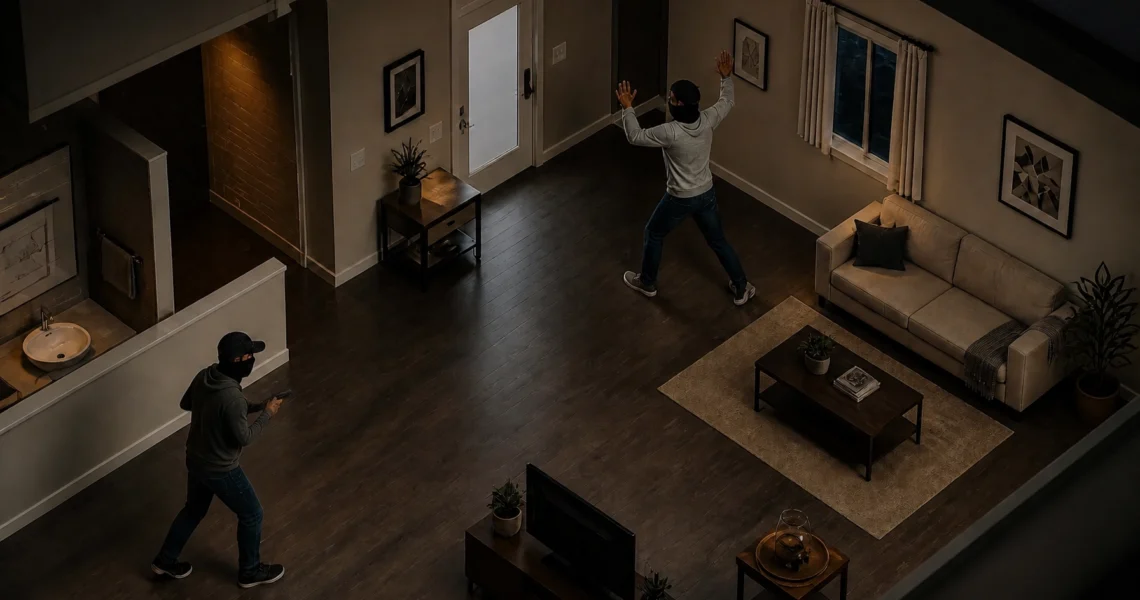
What do you do when an armed intruder enters your home and points a weapon at you or your family?
You do not guess. You do not play action hero. You make a decision based on what the attacker is actually trying to do.
A California home invasion reported on August 25, 2026, shows how quickly that decision can become physical. According to ABC7 News, two suspects allegedly forced their way into a Fremont apartment and assaulted the occupants. During the confrontation, one resident gained control of a suspect’s firearm and fired it, fatally wounding the intruder.
The investigation remains ongoing. The report does not give us every detail of the encounter, and nobody outside that apartment gets to pretend they know exactly what the resident saw, felt, or faced.
But the incident illustrates one hard truth: when an armed assault becomes an immediate threat to life, trained close-quarters control may create a chance to survive.
That does not mean disarm first.
It means knowing when compliance is the safest option: and when compliance has stopped being safe.
Comply when the attacker wants property
Educated Savages will always recommend following the armed person’s instructions when the situation appears to be a conventional robbery.
Give them the phone. Give them the wallet. Give them the keys. Give them whatever material they are demanding.
Most robberies are about material. The attacker wants something they can take and leave with. Your property can be replaced. Your life, your partner’s life, or your child’s life cannot.
Stay calm. Keep your hands visible. Do exactly what you are told and nothing more. Move slowly. If you need to reach for something, tell the attacker what you are doing before you move.
Do not argue. Do not insult them. Do not make sudden movements. Do not chase them after they leave. Do not turn a theft into a fight over a television, a watch, or a damn wallet.
That is not weakness. It is risk management.
Official robbery guidance from organizations such as NSW Police, Victoria Police, and Public Safety Canada consistently emphasizes calm compliance, avoiding sudden movements, and not resisting over property.
The objective is not to win the confrontation. The objective is to get through it alive.
Identify the decision point
Compliance is not a magic rule that applies to every armed encounter forever.
The critical question is simple:
Is the attacker trying to take property and leave, or are they moving toward serious harm?
You may not get a clean answer. Adrenaline destroys neat thinking. Noise, darkness, screaming, injuries, and family members in different rooms can turn a few seconds into chaos.
Still, you need a framework.
Compliance may remain the safest option when:
- The attacker is demanding money, electronics, jewelry, or other property.
- They are giving instructions connected to the immediate scene.
- They appear focused on leaving.
- They are not actively assaulting, restraining, or threatening to execute anyone.
- You can comply without placing yourself or your family in greater danger.
The situation changes when there are clear signals that the attacker’s intent has shifted.
Recognize when compliance stops being safe
Compliance may stop being safe when the attacker begins actively using violence rather than merely threatening it.
Warning signs can include:
- Shooting, stabbing, striking, or assaulting people without needing to do so.
- Making explicit threats to kill or seriously injure someone.
- Attempting to restrain, bind, or incapacitate you.
- Escalating from a demand for property to a demand for control over a person.
- Trying to move you or your family to a vehicle, isolated room, alley, or other secondary location.
- Separating family members while making threats.
- Escalating weapons or bringing another armed person into the encounter.
- Continuing the assault after demands have been met.
A secondary location deserves particular attention. Being told to move a few feet to open a safe is not the same as being forced into a car or taken somewhere isolated. Those situations carry different risks.
No article can tell you exactly what to do in every room, with every attacker, under every state law. Your judgment still matters. So does the possibility of escape. If there is a clear path out, running may be safer than fighting. If escape is impossible, hiding or barricading may buy time.
But if you reasonably believe that you or your family face imminent death or serious injury: and that compliance will not stop it: then the decision has changed.
That is the point where last-resort defensive action may become necessary.

Do not confuse resistance with victory
In self-defense, victory is not dominating the attacker.
Victory is creating a window of opportunity to disengage and escape.
That window may last one second. It may come from an opening near a door, a moment of disrupted balance, a weapon no longer pointed at your family, or a brief break in the attacker’s control.
Once that window exists, you leave.
You do not stand over the attacker. You do not chase them through the house. You do not keep fighting to prove a point. You move yourself and your family toward safety, create distance, call emergency services when safe, and follow instructions from responding officers.
This is where many people get trapped by the fantasy of self-defense. They imagine a clean disarm, a dramatic reversal, and a perfect ending.
Real violence is not clean. It is loud, fast, confusing, and dangerous for everyone in the room: including the person trying to stop it.
Disarming is not a trick
Weapon disarming techniques training is not about memorizing a flashy sequence and hoping it works when someone points a gun at your chest.
A firearm is not a magic wand, but it is still a lethal weapon. A bad grab, a missed angle, a loss of control, or a second attacker can turn a desperate attempt into a fatal mistake.
A functional response requires trained muscle memory built around broad principles:
- Recognizing the direction of the threat.
- Protecting vital areas while moving.
- Closing distance only when distance itself has become the danger.
- Establishing control over the weapon and the attacker’s ability to use it.
- Maintaining that control while moving off the line of fire.
- Accounting for family members, walls, hard surfaces, and other people in the room.
- Disengaging and escaping as soon as a safe opportunity appears.
This is not a home lesson. It is not something to practice with a loaded firearm, a replica in an unsupervised room, or a friend pretending to be an attacker.
The mechanics must be taught progressively by qualified instructors using appropriate training equipment and strict safety controls. The goal is not to make civilians feel invincible. The goal is to expose the difficulty of the problem before a real emergency does it for them.

Train for pressure, not fantasy
Under high adrenaline, fine motor skills degrade. Vision narrows. Hearing changes. People freeze, overreact, or fail to recognize that the situation has already shifted.
That is why practical self defense must include more than technique demonstrations.
You need repetitions. You need movement under pressure. You need communication. You need to make decisions while tired, crowded, startled, and confused. You need to understand how quickly a controlled drill falls apart when the other person resists.
Good training also teaches restraint.
A responsible program does not tell every student to fight every armed person. It teaches the hierarchy:
- Awareness and prevention.
- De-escalation and compliance when the threat is property-focused.
- Escape whenever a viable path exists.
- Barricade or hide when escape is not possible.
- Last-resort physical action when serious harm is imminent and no safer option remains.
- Disengage and escape immediately after creating an opening.
That is the difference between survival training and a hero fantasy.
Our tactical situational awareness training focuses on recognizing danger before physical contact begins. Our close quarters combat training addresses what happens when space disappears and an attacker is already within reach. Both matter because the best disarm is the one you never have to attempt.

Learn the decision before the emergency
The Fremont incident is not a template for civilians to copy. It is a reminder that armed encounters can move from threat to physical struggle in seconds.
Educated Savages’ position is clear:
Comply first when the attacker wants property. Fight only when compliance stops being safe.
If you believe an armed attacker will hurt or kill you or your family even after you comply, do not rely on hope. Rely on preparation, trained responses, and the simplest available objective: create a window, get out, and survive.
That is the purpose of close quarters combat training for civilians and our reality-based self-defense training.
Zero Theory. Zero Filters.
Train for the real decision: not the movie version of it.
This article provides general safety information, not legal advice. Self-defense laws vary by jurisdiction. Seek qualified local legal guidance and professional instruction before making decisions about force or weapon defense.