You Carry a Gun. Do You Still Need Empty-Hand Skills?
October 1, 2026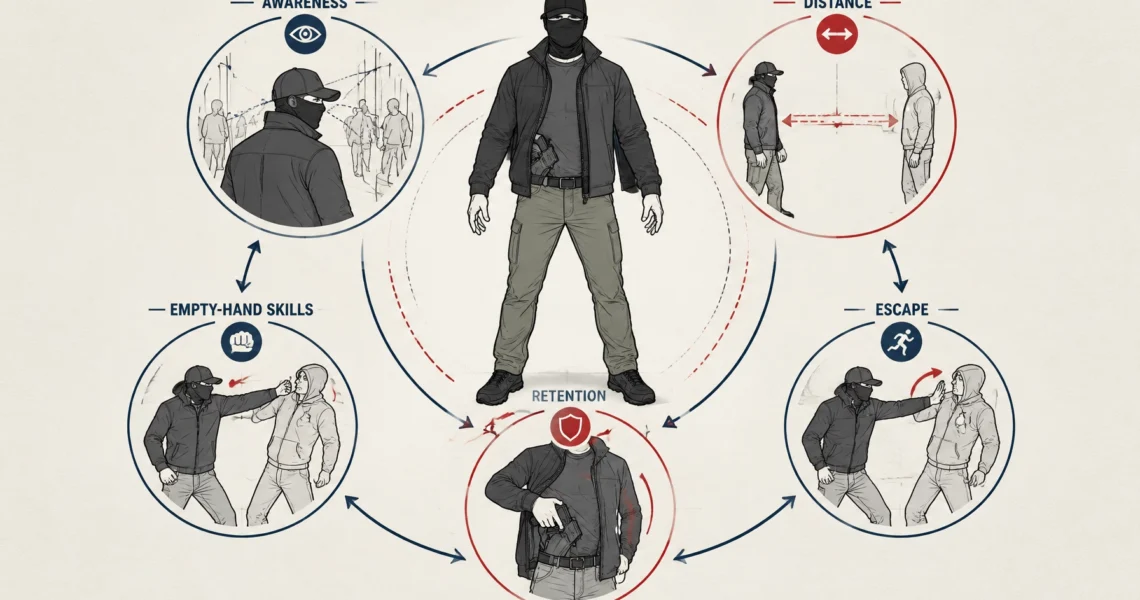
If you carry a gun, what happens when the problem starts too close, too fast, or too messy for the gun to be the right answer?
The answer is yes. You still need empty-hand skills.
That answer makes some armed civilians uncomfortable. It should not. A firearm is a serious tool with a narrow band of circumstances where it may be legally and practically justified. Violent encounters spend most of their time outside that band.
The gun does not solve every problem. It solves one specific version of the problem.
Everything else requires awareness, judgment, distance, movement, communication, and your hands.
Carrying is not the same as being ready
Many armed civilians train almost exclusively at a static range.
They stand still. The target stands still. The distance is known. The environment is controlled. Nobody grabs them, crowds them, pins an arm, knocks them into a wall, or arrives with a second problem from the side.
That practice can have value. Safe gun handling and marksmanship matter. Responsible carriers should understand their equipment, their responsibilities, and the laws governing possession and use.
But a draw stroke on a timer is not the same as being ready for violence.
Readiness means making decisions while surprised, tired, afraid, confused, or physically entangled. It means knowing when your weapon must stay holstered. It means understanding that reaching for a firearm may be impossible, unsafe, unlawful, or all three.
This is where empty-hand self defense training becomes essential.
Not because you should go looking for a fight. The opposite. Practical capability should make you less dependent on a weapon, not more eager to use one.
Distance is the whole problem
A firearm requires time and space to access and use safely. Real-world assaults often begin before that space exists.
Someone is already inside your reach. A hand is on your clothing. Your arm is trapped. You are pressed against a vehicle, doorway, counter, or wall. Your attention is divided because someone is shouting while another person moves behind you.
You cannot shoot your way out of a problem that starts on your chest.
That is not a criticism of firearms. It is a description of distance.
At close range, your first priorities may be staying upright, protecting your head, breaking contact, creating separation, and finding an exit. Those are empty-hand and movement problems. They are also problems where a poorly considered reach toward a weapon can make the situation catastrophically worse.
A responsible carrier needs a survivable layer for the moments when the gun is unavailable or inappropriate.
That layer does not need to look like a movie. It needs to work when your fine motor skills are degraded and your brain is processing too much information at once.

Your weapon can become part of the fight
Carrying a weapon changes the physical problem.
An attacker may not know you are armed. They may grab the side where the weapon is carried. They may pin you against something and reach for it. They may create a close-quarters struggle where your own equipment becomes accessible to them.
That means empty-hand skills protect the thing you are carrying as much as they protect you.
This does not mean memorizing a flashy sequence or treating weapon disarming techniques training like a collection of magic tricks. It means learning how to manage contact, protect your weapon side, recognize when access is unsafe, and create the opportunity to disengage.
The point is not to “win” a wrestling match over a firearm.
The point is to prevent a violent struggle from becoming a weapon-grab problem, then leave as soon as a safe window appears.
Any training involving weapon awareness or retention should be taught by qualified instructors using appropriate inert equipment, clear safety controls, and progressive pressure. Never practice these concepts with a loaded firearm or improvise a backyard drill with a friend. That is not serious training. That is how people get hurt.
Most confrontations do not justify deadly force
A shoving match outside a bar. Someone mouthing off in a parking lot. A drunk friend grabbing your shirt. A heated domestic argument. A stranger trying to provoke you.
These situations can become dangerous. They can also be exactly the wrong situations for a firearm.
Deadly force is generally associated with an imminent threat of death or serious bodily harm, but the legal standard varies by jurisdiction. Carry laws, use-of-force rules, duty-to-retreat requirements, defense-of-property laws, and self-defense standards differ from state to state and sometimes depend heavily on the facts.
This is not legal advice. Know the law where you live. Review it regularly. Consult a qualified attorney licensed in your jurisdiction.
The practical point is simple: many confrontations remain below the threshold where deadly force could be lawful. In those moments, the tools are awareness, verbal boundaries, movement, distance, and empty-hand skills.
A carrier who treats every confrontation as a gun problem is not prepared. They are dangerous to themselves and everyone nearby.
Awareness still outranks hardware
The best defensive tool is often the one that gives you more time.
Notice the environment before you need it. Identify exits. Watch changes in behavior. Pay attention to hands, distance, barriers, and people who are trying to isolate or redirect you. Leave early when something feels wrong.
That is not paranoia. It is basic survival training.
Our guide to tactical situational awareness covers the habits that help you recognize problems before contact begins. Awareness gives you options. Hardware does not replace options.
De-escalation matters too. A calm voice, visible hands, a clear boundary, and a decision to leave can prevent an encounter from becoming physical. There is no prize for standing your ground in an argument that does not need to happen.
If you can disengage safely, disengage.
If you can move toward people, light, staff, or an open business, move.
If you can avoid the confrontation entirely, that is the win.
Multiple attackers change the math
One attacker is already a difficult problem. Multiple attackers change the problem entirely.
A one-on-one mindset can trap you. You may become fixated on the person directly in front of you while another person moves behind you. A prolonged ground exchange can remove your mobility and your ability to see what is happening around you.
This is one reason street fight defense training must include movement, scanning, staying upright when possible, and getting out of the area. The goal is not to dominate several people. That is fantasy and bad math.
The goal is to avoid being surrounded, create a path, and escape.
A firearm does not erase the presence of bystanders, family members, poor visibility, hard surfaces, legal restrictions, or unknown people behind the threat. It certainly does not turn a chaotic situation into a clean one.
What the empty-hand layer should include
You do not need a black belt to become harder to control.
You need a basic, pressure-tested layer that supports survival:
- Managing distance without freezing.
- Creating separation when someone crowds or grabs you.
- Breaking common grips and controls on your body.
- Recognizing and defending against chokes and headlocks.
- Staying on your feet when possible.
- Protecting the side where your weapon is carried.
- Recovering from the ground without treating the ground as home.
- Moving toward an exit instead of chasing a fight.
- Using simple gross-motor actions under adrenaline.
- Recognizing when to stop engaging and leave.
This is the difference between hand to hand combat training and collecting techniques for their own sake.
At Educated Savages, our reality-based self-defense training is built around practical problems: pressure, confusion, contact, bad footing, limited space, and the need to escape. No ego. No fantasy. No assumption that the attacker will cooperate.

Train scenarios, not just repetitions
Static repetition has a place. It builds familiarity.
But responsible carriers should also seek scenario work, supervised force-on-force training, grappling and clinch fundamentals, standing escapes, decision-making under fatigue, and controlled exposure to pressure. Training should test whether you can still think when your breathing is hard and your plan has fallen apart.
Any firearm-related training should remain under a qualified professional, in a controlled setting, with safe equipment and strict rules. This article will not tell you how to draw, point, or fire at another person. Those decisions carry grave safety and legal consequences.
The more important skill is often knowing when not to access the weapon at all.
That judgment is not built by chasing speed. It is built by understanding context.
Our armed intruder decision framework states the doctrine plainly: comply when the attacker wants property and compliance remains safe. Material can be replaced. Do not turn a robbery into a fight over a wallet, phone, or vehicle.
If compliance stops being safe and you or your family face an immediate threat of death or serious harm, action may become necessary. In that extreme situation, people must rely on trained muscle memory rather than panic, but no article can determine the facts of your encounter or the law governing it.
Victory is not winning an exchange.
Victory is creating a window to disengage and escape.
The legal aftermath does not disappear
Carrying a gun does not end when the encounter ends.
There may be police contact, detention, an investigation, witness statements, evidence collection, prosecutorial review, a grand jury, civil exposure, and years of legal weight. The fact that you were afraid does not automatically make every action lawful. The fact that you carried legally does not automatically justify using the weapon.
Laws vary by jurisdiction. Facts matter. Consult a qualified local attorney for legal guidance, not a social-media comment section.
After a defensive incident, follow emergency instructions, prioritize immediate safety, identify injuries, and avoid turning the event into an online performance. Do not post a play-by-play. Do not speculate publicly. Do not assume the legal process will care about the story you wanted to tell.
Responsible carry includes responsible aftermath.
The reverse myth is also nonsense
Some people hear this and argue that empty-hand skills make a firearm unnecessary.
That is nonsense.
Different tools solve different problems. A firearm may be relevant in circumstances where an empty-hand response cannot stop an imminent threat of death or serious harm. Empty-hand skills matter when the distance is too close, the situation does not justify deadly force, the weapon is inaccessible, or using it would create greater danger.
The point is not to choose a team.
The point is to understand which window you are in.
A responsible civilian should not be encouraged to carry a weapon, and should not be shamed for lawful carry. They should be encouraged to understand the burden that comes with the decision and train beyond the range.
Explore our broader practical self-defense guide for the other layers: awareness, movement, pressure, and escape.
The gun is one answer
The gun is one answer to one narrow question.
Everything else in your life is answered by awareness, judgment, distance, communication, and your hands.
That is why serious self defense classes should not treat armed civilians as people who have graduated from empty-hand work. Carrying should make you more disciplined, not less. More selective, not more aggressive. More committed to avoiding stupid confrontations, not more confident about taking them.
Train the gap.
Learn to function when space disappears. Learn to protect yourself and the weapon you carry. Learn to stay upright, create separation, and leave. Learn the law where you live. Learn when compliance is the smart move.
And remember the standard:
Do not fight to prove a point.
Do not access a weapon because your ego got bruised.
If immediate serious harm leaves no safer option, rely on trained responses, and disengage the moment you can.
Zero Theory. Zero Filters.
Free first class at Educated Savages: Monday, Wednesday, or Friday at 7:00 PM in Downtown Miami. Ages 15 and up. All fitness levels welcome.
This article provides general educational information, not legal advice. Carry laws, use-of-force standards, and self-defense law vary by jurisdiction. Consult a qualified attorney in your state before making decisions about firearms, force, or self-defense.