5 Self-Defense Moves That Work When Adrenaline Hits (No Theory, Just Action)
July 29, 2026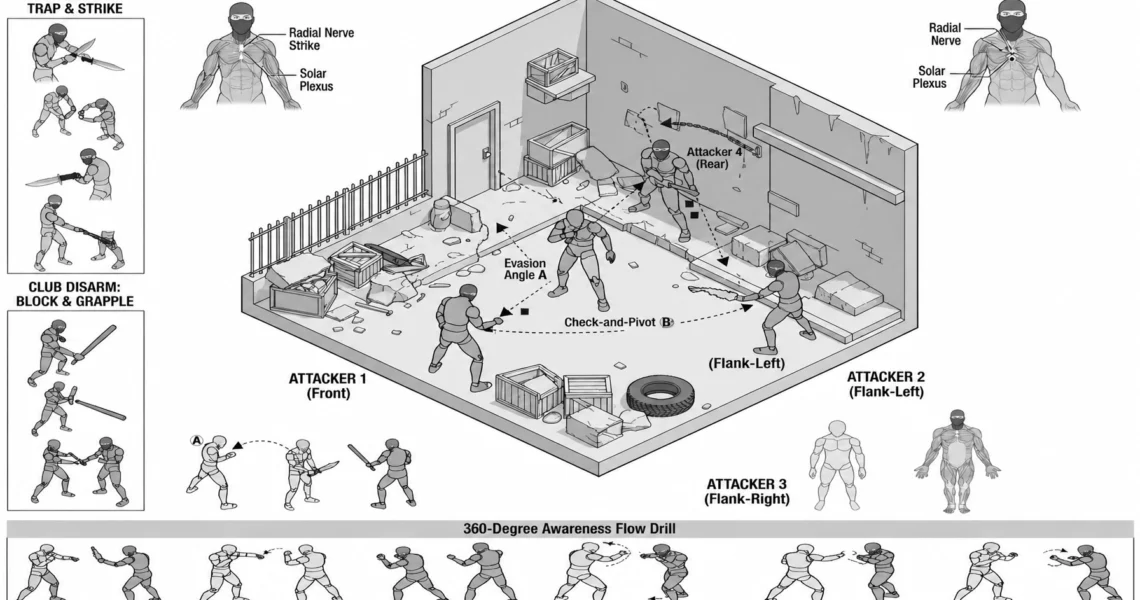
When it comes to tactical self defense miami, preparation is everything.
Ever wonder what happens to your precious martial arts kata when a fist comes flying at your face at full speed and your heart rate rockets past 180 beats per minute? Here’s a reality check: fine motor skills turn to absolute garbage. The moment an unexpected threat manifests, your body triggers a primal surge of stress hormones. When violent confrontation erupts, mastering real-world adrenaline response self defense is the difference between freezing in panic and surviving intact.
Cortisol surges, tunnel vision restricts your peripheral view, auditory exclusion muffles sound, and your hands start shaking uncontrollably. If your defensive strategy relies on complex wrist locks, multi-step pressure point strikes, or intricate joint manipulations, you are setting yourself up for catastrophic failure. Understanding the biological reality of adrenaline response self defense allows you to strip away useless, complex techniques and replace them with raw, high-percentage gross motor actions that work when your nervous system is on fire.
When your body enters the classic fight-or-flight response, blood dumps out of your extremities and rushes directly to your heart, lungs, and major muscle groups. This survival mechanism optimizes your body for simple, explosive movements—pushing, pulling, pounding, and sprinting. In this guide, we break down 5 reliable tactics engineered specifically for violent encounters, cutting through theoretical fluff so you can protect yourself when it matters most.
The Science Behind Adrenaline Response Self Defense
When adrenaline spikes beyond normal baseline levels, your heart rate quickly shoots past 120 Beats Per Minute (BPM), passing the optimal performance zone (95 to 115 BPM) and heading straight into the high-stress red zone (175+ BPM). At this extreme level of physiological arousal, cognitive processing slows down while primal survival instincts take over completely.
In effective adrenaline response self defense, we focus exclusively on gross motor skills—movements that utilize large muscle groups and simple kinetic chains without requiring finger dexterity, precise spatial timing, or complex coordination. Fine motor skills (like grabbing a single finger or pinching a tendon) completely evaporate under threat conditions. Complex motor skills (like executing a spinning kick or multi-phase block combination) deteriorate rapidly as heart rates climb.
To prevail under high-stress conditions, your self-defense arsenal must consist of techniques that leverage natural startle flinch responses rather than fighting against them. By building your tactics around what your body does naturally when frightened, you eliminate reaction lag and maximize striking power.
5 Moves Built for Adrenaline Response Self Defense
Below is an example of tactical posture and hand positioning when preparing to defend yourself under extreme stress:

Move 1: The Open-Palm Heel Strike
When your hands are shaking and adrenaline is surging, making a perfectly tight fist and aligning your wrist bone properly becomes surprisingly difficult. Striking a hard object like a skull with a closed fist without hand wraps often results in broken metacarpal bones—commonly known as a boxer’s fracture.
The palm heel strike solves this problem instantly. By driving the broad, heavy heel of your palm upward into an attacker’s chin, nose, or midsection, you utilize the large muscles of your legs, hips, and core without risking broken fingers.
- How to execute: Keep your fingers extended and slightly curled back to avoid hyper-extension. Drive forward off your back foot, rotating your hips into the blow. Aim through the base of the attacker’s chin or central facial structure.
- Why it works under stress: It requires zero fine motor dexterity. Even if your target shifts slightly, the broad surface area of your palm heel makes devastating impact, making it a cornerstone of functional adrenaline response self defense.
Move 2: The Downward and Off-Angle Hammer Fist
When humans are threatened or overwhelmed, our natural instinct is to pound downward with a heavy, swinging motion—much like driving a spike into the ground. The hammer fist harnesses this exact biological instinct.
Instead of striking with small knuckles, you hit using the fleshy, thick bottom heel of your clenched fist, backed by the full momentum of your arm and shoulder trunk.
- How to execute: Raise your arm slightly above your shoulder line and drive your fist down or across in a heavy chopping arc. Target the jawline, side of the neck, collarbone, or bridge of the nose.
- Why it works under stress: The bottom of the hand is heavily padded by muscle, drastically reducing the risk of self-injury. It uses massive gross motor power from the lats, shoulders, and core, which is why it fits perfectly into an adrenaline response self defense system.
Move 3: The Close-Range Spear Knee Strike
In close quarters—such as a crowded hallway, entryway, or when someone aggressively grabs your jacket—you lose the physical distance needed to throw effective long-range punches. Trying to execute complex throw techniques or high kicks in close proximity is a recipe for disaster.
The close-range knee strike relies on the body’s strongest muscle groups: the glutes, hamstrings, and quadriceps.
- How to execute: Grab the attacker’s shoulders, arms, or neck to secure structural control. Drive your hip forward, thrusting the hard bony point of your knee straight into the attacker’s groin, thigh, or lower abdomen.
- Why it works under stress: It requires minimal balance or timing precision. You are driving your largest joint straight upward through the target, making this tactic crucial for adrenaline response self defense in tight spaces.
Move 4: The Low Shin Kick and Foot Stomp
High head kicks look incredible in martial arts films, but standing on one leg while high on adrenaline severely compromises your center of balance. A low kick or direct foot stomp keeps both feet near the ground while inflicting immediate structural disruption.
- How to execute: Drive the instep or shin bone straight into the attacker’s outer thigh (targeting the sciatic/peroneal nerves), shin, or knee joint. Alternatively, lift your boot and drive your heel down onto their foot instep.
- Why it works under stress: Keeping your feet below waist level ensures you maintain posture even when tunnel vision narrows your perception. It is an essential low-risk tool for adrenaline response self defense that disrupts an attacker’s mobility without risking a fall.
Move 5: The Frame, Push, and Breakaway
Self-defense is not about fighting to win a championship belt or points on a scoreboard; it is about staying safe and getting home alive. The final and most critical move is creating immediate structural separation using your forearms, followed by an immediate sprint toward safety.
- How to execute: When an attacker rushes in, bring both forearms up horizontally across your head and chest to form a rigid triangular frame. Drive the frame into the attacker’s chest or shoulders to absorb their force, push off powerfully, turn, and sprint toward an exit.
- Why it works under stress: This move builds directly upon the body’s natural startle flinch (raising arms to cover the face). By transforming a flinch into a solid structural shield, you protect your head and create room to run. The primary goal of any genuine adrenaline response self defense scenario is rapid survival and escape.
Practical Training Methods for Adrenaline Response Self Defense
Knowing these moves conceptually is only 20% of the battle. Under high stress, you will not rise to the level of your expectations; you will sink to the level of your training. To ensure your body executes these gross motor moves instinctively, you must incorporate realistic stress-inoculation drills into your routine.
Enhance your personal protection foundation by developing strong situational awareness habits to recognize environmental red flags long before physical contact occurs. Additionally, consistent heavy bag work, target pad sprints, and light scenario training while physically fatigued will simulate the physical sensation of an intense adrenaline dump.
When you structure your workouts around high-intensity interval conditioning followed immediately by power pad strikes, you train your mind to remain focused while under physical exhaustion. For a deeper breakdown on organizing functional combative workouts, explore our full guide on modern combatives training.
To make adrenaline response self defense techniques second nature, you must train under pressure. Repeated controlled exposure to mild physical stress reduces the initial panic spike, allowing you to maintain clear decision-making when an actual threat arises.
Key Takeaways for Adrenaline Response Self Defense
- Keep it simple: Abandon fine motor techniques like finger locks or intricate wrist manipulations under severe stress.
- Rely on gross motor skills: Focus on heavy muscle groups—palm heel strikes, hammer fists, spear knees, low kicks, and structural frames.
- Train under pressure: Replicate elevated heart rates during workout sessions to prepare your mind and body for the biological reality of fight-or-flight reactions.
- Prioritize escape: The highest form of self-preservation is creating space and exiting the danger zone as rapidly as possible.
By implementing a realistic adrenaline response self defense mindset, you ensure that your body acts instinctively, giving you the best possible outcome when violence threatens your safety.
Compare our training: Combatives vs MMA | CQC vs BJJ
FAQ
Q: What does tactical self defense miami entail?
A: It is real-world survival training and stress inoculation.
Q: How does this differ from sport MMA?
A: We focus on practical combatives rather than ring rules.
Q: Why choose this over BJJ?
A: Our focus is strictly on real world CQC and multi-threat scenarios.