You Won’t See It Coming: How to Train for a Surprise Attack (And Why It’s Worth It)
September 16, 2026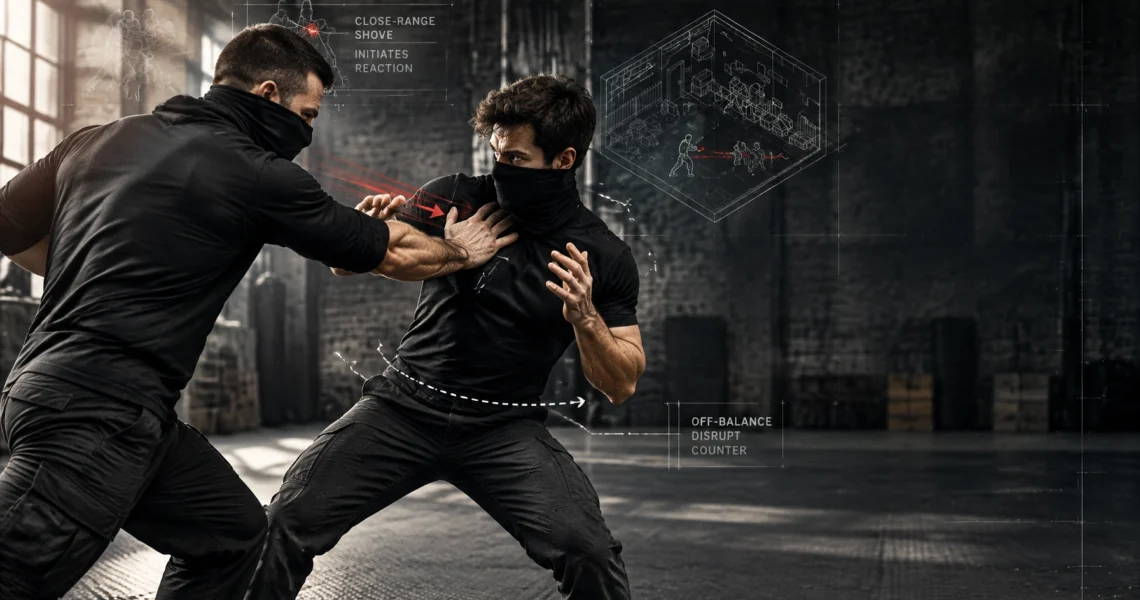
What happens when the first warning is already someone’s hands on you?
You do not get a countdown. You do not get a respectful bow. You do not get time to choose your favorite technique.
A surprise attack starts before you are ready. It may be an ambush, a preemptive strike, a sudden grab, a shove into a wall, or a punch thrown while your attention is somewhere else. Real violence often begins this way: not as a consensual duel between two people standing square and waiting for the bell.
That changes how you need to train.
If your self defense training only works when you know exactly when the attack is coming, it is not ready for the street. It is ready for a drill.
A surprise attack is not a fight
A surprise attack is an assault that begins before you have identified the threat or prepared your body.
You may be:
- Walking to your car
- Talking to someone who suddenly changes their behavior
- Looking down at your phone
- Carrying groceries
- Moving through a doorway
- Helping a family member
- Trying to leave an argument
- Turning your head after hearing a noise
The attacker may use distraction, deception, positioning, or speed. The first contact might be a strike, a grab, a tackle, a shove, or an attempt to drag you somewhere.
This is why practical self defense cannot be built around the idea that both people will be ready at the same time. You need to train from bad positions, poor awareness, and incomplete information.
The objective is not to dominate the attacker. The objective is to survive the first seconds, recover your position, create a window, and escape.
That is the win.
For more on recognizing danger before contact, see our guide to tactical situational awareness.

Most training starts too clean
Most martial arts and combat drills begin with a known trigger:
- Partners face each other.
- Both people are ready.
- Someone calls “go.”
- The attacker performs a familiar movement.
- The defender applies a rehearsed response.
That has value. You need to learn mechanics before you can pressure-test them.
But it does not fully prepare you for surprise.
A clean drill teaches anticipation. You see the stance, recognize the movement, and begin your answer before the attack has properly started. That is not the same as reacting to a threat that appears without warning.
Street fight defense training has to include uncertainty. The attack should not always come from the front. The timing should not always be predictable. You should not always be standing in a perfect stance with both feet planted and your hands ready.
Otherwise, you may develop a dangerous illusion of competence.
You know what to do when the drill looks familiar. You do not yet know whether you can access that response when your brain is trying to understand what the hell just happened.
Your body will flinch before you think
The startle reflex is automatic. A sudden movement, loud sound, unexpected touch, or impact can cause you to blink, tense your shoulders, raise your hands, hold your breath, and pull your body away.
That reaction is not weakness. It is your nervous system trying to protect you.
The problem is what happens next.
Some people freeze. Their body locks up for a moment while the brain processes the threat. Others rush forward without a plan, lose their balance, stare at the attacker, or focus so completely on one person that they miss the exit, a second attacker, or a weapon.
Stress can also produce:
- Tunnel vision
- Auditory exclusion
- Poor fine-motor control
- Time distortion
- Loss of memory
- Shallow or held breathing
- Delayed decision-making
You cannot simply order yourself to “stay calm” and expect biology to cooperate. The better goal is to become functional under stress.
You train your natural flinch to become useful: protect your head, regain your base, move off the line, create space, identify the exit, and act.
Train the first movement
Start with a simple defensive response that works from a bad position.
For most civilians, that response should not be a complicated sequence of small hand movements. Under adrenaline, fine motor skills degrade. Keep the first actions gross, simple, and repeatable:
- Exhale instead of holding your breath.
- Bring your hands up to protect your head and neck.
- Bend your knees and recover your balance.
- Move off the direct line of attack.
- Use a strong frame or barrier to create space.
- Look for the exit and start moving.
This is not about standing still and “blocking” forever. It is about buying a fraction of a second and using it to leave.
In unarmed CQC training, the first response should connect protection to movement. Cover, angle, space, exit. That sequence is easier to access than a long catalog of techniques.

Make the training unpredictable
You cannot safely recreate a real ambush by letting people attack each other recklessly. That is not serious training. That is negligence dressed up as toughness.
A competent instructor controls intensity, equipment, targets, and timing. The goal is uncertainty: not injury.
Useful progressions include:
Change the signal
Do not always begin with “go.” Use varied, agreed-upon signals such as a clap, verbal cue, movement, or touch. The student should know the possible signals but not exactly when one will occur.
Change the timing
Use random pauses. Sometimes the response begins immediately. Sometimes it begins after ten seconds of ordinary movement. This prevents the student from simply waiting for the attack.
Change the angle
Work from the front, side, and rear. Include attacks that begin while the student is turning, walking, sitting, standing up, or carrying an object.
Add distraction
Have the student answer a question, carry a bag, look for a door, or move through a crowded training space. The drill should challenge attention without becoming chaotic or unsafe.
Add controlled pressure
Use protective equipment, verbal pressure, physical fatigue, and limited-contact scenarios. Keep the intensity progressive. The student must still be able to learn, breathe, and make decisions.
This is stress inoculation: controlled exposure that helps the nervous system recognize pressure without immediately shutting down.
Use scenarios, not just techniques
Scenario training forces you to solve a problem instead of performing a memorized response.
A scenario might begin with:
- A stranger closing distance during a verbal confrontation
- A sudden shove near a wall
- A grab from the side while walking
- A surprise tackle attempt
- A family member being pulled away
- A threat appearing near a doorway or vehicle
The scenario should have a clear objective. Protect yourself. Protect someone else if realistically possible. Create distance. Reach a safe location. Call for help.
Do not turn every scenario into a prolonged fight. That teaches the wrong lesson.
The best outcome is usually the shortest path to disengagement.
Your instructor can also use a simplified OODA loop:
- Observe: What changed?
- Orient: Where is the threat, and where is the exit?
- Decide: Is escape, compliance, or defensive action safest?
- Act: Move immediately and keep moving toward safety.
Training should make that loop faster without pretending you can process unlimited information under stress. Pre-planned responses reduce the amount of decision-making required in the first moment.
Awareness beats reaction time
The best surprise attack is the one you notice early enough to avoid.
Pre-contact awareness does not mean treating every stranger as a threat. It means noticing behavior, distance, positioning, exits, and changes in the environment.
Look for:
- Someone managing distance unusually fast
- Hands hidden or repeatedly reaching
- Sudden shifts in tone or posture
- Attempts to isolate you
- A person blocking your path
- Multiple people positioning around you
- An argument that keeps moving closer
You are not trying to predict the future. You are trying to avoid being completely unprepared.
If something feels wrong, create distance, use your voice, move toward people and light, and leave early. Do not wait for certainty. Certainty often arrives after contact.
Armed encounters require a different standard
If a weapon appears, compliance and escape come first whenever possible. Give up property. Use your voice. Avoid sudden movements. Look for a safe opportunity to disengage.
Do not treat a weapon disarm as a clever party trick.
A disarm should only be considered when you or someone with you faces an immediate threat of death or serious harm and there is no safer option. In that extreme situation, training and muscle memory may give you a chance to act: but there are no guarantees, and the goal remains escape, not control.
Our approach to knife defense training follows that standard: awareness, avoidance, compliance when appropriate, and decisive action only when necessary to survive.
The benefits are practical
Training for surprise attacks produces benefits beyond learning a set of CQC techniques.
Shorter reaction time
You learn to move during the first moment of shock instead of waiting until your brain has completed a perfect analysis.
Faster decisions under adrenaline
Repeated scenarios make basic choices more familiar: cover, angle, space, exit, call for help.
Less freezing
You may still feel fear. You may still flinch. The difference is that your flinch has somewhere to go.
Better recovery
If you are knocked off balance, surprised, or forced against a wall, you learn to recover position instead of mentally resetting the drill.
Confidence that survives uncertainty
Real confidence is not believing nothing bad can happen. It is knowing you have practiced functioning when conditions are ugly and incomplete.
Better escape habits
You stop measuring success by whether you “won” the fight. You measure it by whether you protected yourself, created an opening, and got away.
That is survival training: not fantasy.

Train for the first bad second
You cannot guarantee that you will see an attack coming. No serious instructor should promise that.
You can train what happens after the surprise.
Start with simple protective movements. Add random timing, changing angles, distraction, fatigue, verbal pressure, and controlled contact. Practice scanning before contact. Build an OODA loop that does not require a perfect view of the situation.
Then test yourself without turning training into reckless theater.
The point of hand to hand combat training is not to become invincible. It is to remain usable long enough to make a better decision. Cover your head. Stay on your feet if you can. Create distance. Find the exit. Leave.
That is what effective self defense looks like when the first move is not yours.
Ready to train without the countdown?
Educated Savages offers practical self defense, CQC, and survival-focused training for civilians of all experience levels, ages 15 and up. Join a free first class on Monday, Wednesday, or Friday in Miami and learn how to train for the conditions that actually matter.