Tunnel Vision Under Stress: Why You Go Blind in a Fight and How to Train Past It
September 10, 2026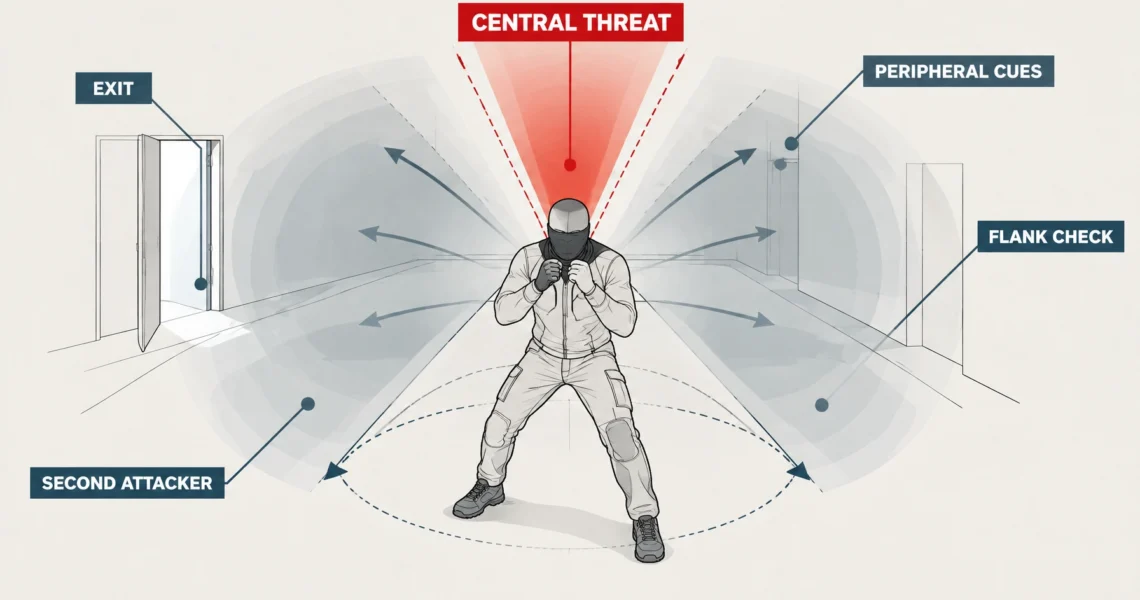
Have you ever been so locked onto one threat that the rest of the world seemed to disappear?
That is tunnel vision under stress. In a violent encounter, you may stare at the person in front of you and miss the second attacker, the weapon in their hand, the exit behind you, or the person closing from your flank.
You are not weak. You are not a coward. Your nervous system is doing what it was built to do: prioritize the most immediate danger and cut away everything it considers secondary.
The problem is that real violence rarely stays simple.
***
Tunnel vision is attention narrowing
“Tunnel vision” sounds like your eyes physically stop working around the edges. Usually, that is not what is happening.
Under extreme stress, your attention narrows. Your eyes may still receive information from the sides, but your brain gives less priority to processing it. Research on stress and visual attention describes this as attentional narrowing rather than a literal loss of the visual field. PubMed research on stress and visual attention discusses how stress can reduce the range of cues people use.
The body is shifting into a high-alert state through sympathetic nervous system arousal. Adrenaline and other stress chemicals prepare you to act quickly. Heart rate rises. Muscles tense. Breathing changes. Your brain starts filtering information according to one brutal question:
What is the immediate threat?
That response can help you focus on a punch coming toward your face. It can also make you blind to everything that matters next.
You may experience:
- Reduced awareness of peripheral movement
- Difficulty tracking more than one person
- Auditory exclusion or muffled hearing
- Loss of fine motor control
- Time distortion, where events feel slowed down or compressed
- Difficulty speaking, deciding, or remembering details
- A strong fixation on the attacker’s face, hands, or weapon
This is why people sometimes report that a violent encounter felt strangely quiet or happened in slow motion. The clock did not change. The brain’s processing and memory systems did.

***
It is not a toughness problem
“Just stay calm” is advice people give because they do not know what else to say.
It is also mostly useless.
You cannot order your nervous system to remain at a relaxed baseline while someone is trying to hurt you. Telling yourself to be calm does not create peripheral awareness, fine motor control, or decision-making ability. If anything, failing to stay calm can make you feel even more helpless.
Tunnel vision is a biological response, not a personality test.
A trained person can experience it. A physically strong person can experience it. Police officers, soldiers, athletes, medical workers, and ordinary civilians can all experience perceptual narrowing when the stakes become high enough.
The goal of self defense training is not to eliminate the stress response. That is fantasy. The goal is to recognize it, manage it, and build habits that still function while it is happening.
Think of it this way: you are not trying to become fearless. You are trying to become usable under pressure.
That requires practical self defense training, not motivational slogans.
***
Tunnel vision creates tactical blind spots
In a real violent encounter, tunnel vision can cause several immediate problems.
You miss the second attacker
Your brain locks onto the person directly in front of you. Someone else may move in from the side or rear without registering as a priority.
This is one reason multi-person scenarios are so different from controlled one-on-one sparring. The person you are looking at may not be the only problem.
You miss the weapon
You may see an aggressive person but fail to notice the object in their hand. Or you may fixate on the weapon and lose awareness of the person’s movement, their accomplice, or your available escape route.
With an armed threat, compliance and escape come first whenever possible. Give up property. Follow instructions. Create distance when you safely can. Call emergency services.
A disarm is not a clever party trick. It is an extreme last resort if you or your family face an immediate threat of death or serious harm and there is no safer option. In that situation, you must rely on trained muscle memory: not improvisation, ego, or some technique you watched once online.
You miss the exit
Your body may be physically close to an open door, stairwell, vehicle, or public area, but your attention stays glued to the attacker.
That is a serious failure of orientation. The purpose of self-defense is not to win a street fight. Victory is creating a window to disengage and escape.
You miss the person closing on your flank
Tunnel vision often pulls your head and shoulders toward the threat. Your feet stop moving. Your posture becomes fixed. You fight the person you can see while giving someone else a clear angle.
The solution is not to stare harder. It is to train your attention to break fixation.
***
What training past tunnel vision looks like
You cannot practice real violence safely. You can, however, train the specific problems stress creates.
1. Use progressive stress inoculation
Start with simple drills at a low pace. Add movement, noise, fatigue, time limits, verbal pressure, and unpredictable cues gradually.
The point is not to terrify people or create macho chaos. The point is controlled exposure. Your nervous system learns that elevated heart rate and pressure do not automatically mean total shutdown.
A good instructor should be able to scale the drill for beginners, teens, older adults, and experienced students. More intensity is not always better. Sloppy panic teaches sloppy panic.
2. Deliberately widen the visual field
When people become fixated, they often stare directly at the threat. Training should teach them to keep the eyes active and the head moving.
Use simple prompts:
- “What is on your left?”
- “Where is the exit?”
- “Who else is moving?”
- “What are the hands doing?”
- “What changed behind you?”
The goal is not to spin around randomly. It is to unlock attention from one point and gather enough information to move intelligently.
3. Train the head-turn and exit check
In close quarters combat training, every defensive exchange should connect to orientation.
After creating space or breaking contact, turn the head and check:
- The immediate threat
- The hands
- The surrounding space
- The nearest usable exit
This check should be trained until it becomes automatic. Under stress, you will not calmly remember a lecture about situational awareness. You will perform what you have repeated.

4. Add peripheral cues under fatigue
Have a trainee work pads, move, or perform a short conditioning burst. While they are breathing hard, place simple visual cues to the side: a colored card, a number, a hand signal, or a partner stepping into view.
The trainee must identify the cue without abandoning the primary task.
Keep it simple at first. The objective is to build peripheral awareness while tired, not to create a circus.
Over time, combine physical effort with a scan, a verbal response, and a movement decision. That is closer to the cognitive mess of a real emergency.
5. Add verbal and decision-making tasks
Stress can affect speech and reasoning as much as movement. Have students practice short commands:
- “Back up.”
- “Call 911.”
- “Move.”
- “Left.”
- “Exit.”
Then add choices: move toward the door, identify the safe path, protect a training partner, or disengage when the threat changes.
This is where survival training becomes more than hitting pads. You are teaching the brain to observe, decide, communicate, and act while the body is under load.

***
Keep the techniques simple
Tunnel vision and high adrenaline are terrible environments for complicated movements.
Fine motor skills degrade. Precise grips become harder. Multi-step combinations become slower. Complex choices create hesitation.
That does not mean every situation can be solved with one magic technique. It means your core responses should be built around simple, repeatable actions:
- Protect your head
- Stay on your feet when possible
- Create space
- Move off the line
- Use your voice
- Scan for additional threats
- Find the exit
- Leave as soon as you can
Your adrenaline response self-defense training should account for narrowed attention, reduced coordination, and auditory exclusion. Your tactical awareness training should reinforce scanning before, during, and after movement.
Breathing can help lower arousal enough to make a better decision, but breathing is not a magic reset button. You may only get one controlled breath. Take it when you can. Then act.
***
The real objective is escape
Fighting can become necessary. It should not become the objective.
If someone threatens you, create distance and leave if you can. If an armed person demands property, compliance is usually safer than resistance. If a family member is with you, move them toward safety when possible. Call emergency services and seek medical attention after the danger passes.
If immediate violence leaves no safe path out, use the skills you have trained to create a brief opening. Then disengage.
That is practical self defense. Not domination. Not proving toughness. Not standing around to finish the fight.
A good CQC training program should prepare you for the moment your vision narrows, your hearing changes, your hands shake, and your brain wants to stare at one problem forever.
Train the scan. Train the head turn. Train the exit check. Train simple movements under pressure.
You do not need to become superhuman.
You need to stay functional long enough to get out.
***
Train with Educated Savages
Educated Savages builds practical self defense around real-world pressure, simple mechanics, and decision-making under stress.
Your first class is free. Group classes meet Monday, Wednesday, and Friday in Miami at 7:00 PM. See the schedule and register here.
If tunnel vision, freezing, or pressure-based training has been a concern, tell the instructor before class. We train seriously, but we do not need to turn every drill into a damn war zone to make it useful.