Self-Defense Classes in Miami: How to Tell Real Training From Theater Before You Pay
September 23, 2026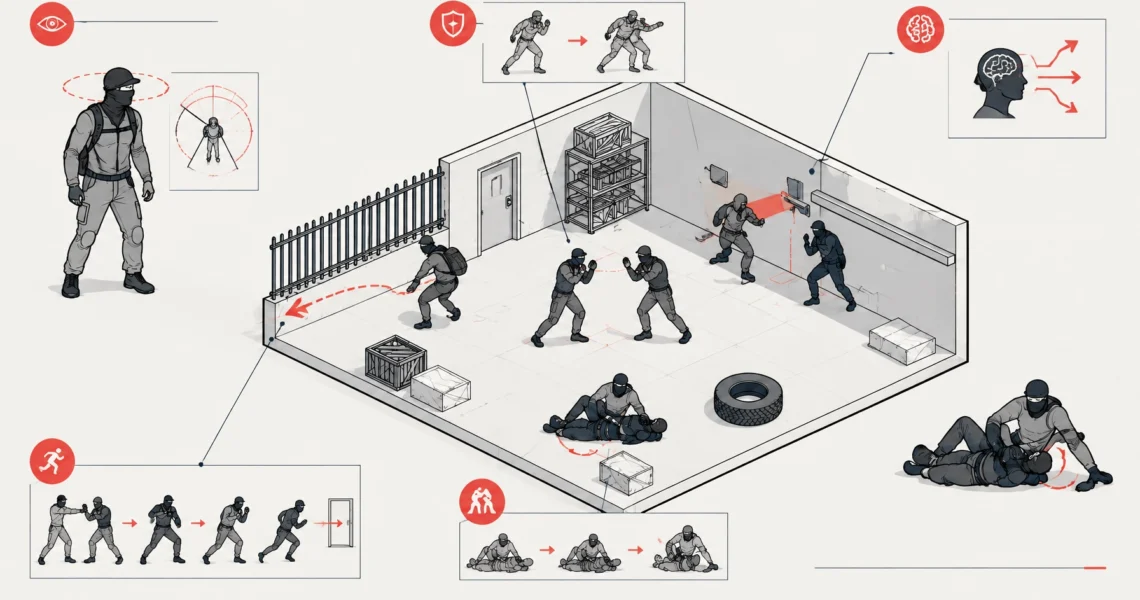
Are you looking for self-defense classes in Miami, or are you about to pay for a rehearsed performance with a monthly contract?
That is the question.
A clean uniform, a wall of trophies, and a confident instructor do not prove that a program prepares you for real violence. Neither does a dramatic demonstration where a compliant partner stands still while a perfect disarm unfolds.
This is the filter. Use it before you sign anything.
Look for application, not choreography
Real self-defense training should answer one basic question:
Can a reasonably trained person use this under pressure, fatigue, confusion, and resistance?
If the answer depends on a partner grabbing your wrist in exactly the right way, waiting politely, and allowing you to complete six steps, you are watching theater.
That does not mean every drill must be chaotic from day one. Beginners need clear instruction. They need to understand posture, balance, distance, movement, and basic mechanics. But the training should progress toward resistance. Partners should move. They should make mistakes. They should apply pressure. Eventually, the student should have to make decisions instead of reciting choreography.
Look for a program that includes:
- Awareness and avoidance before physical contact
- Verbal boundary-setting and de-escalation
- Striking, clinch work, takedowns, and ground survival
- Training against grabs, chokes, and common attacks
- Multiple-attacker awareness and movement
- Weapons awareness without Hollywood disarm fantasies
- Resistance-based drills and controlled scenario work
- Escape as the end goal
At Educated Savages, our approach is Zero Theory, Zero Filters. That does not mean reckless training. It means removing the ego, rituals, and sport assumptions that do not help a civilian get home safely.

Rank is not experience
A black belt can represent years of dedication. It can also represent very little about how an instructor performs under real pressure.
Ask where the instructor’s experience comes from. Ask what they have actually tested. Ask whether they have trained with resistance, worked in close quarters, managed high-adrenaline situations, or taught civilians with different bodies, ages, and fitness levels.
You are not looking for a war story. You are looking for evidence of sound judgment.
A good instructor should be able to explain:
- Why a technique works
- When it may fail
- What changes when the attacker is larger or stronger
- What happens if there is a second attacker
- How the environment affects the decision
- When the safest option is to disengage
- What the student should do after reaching safety
Anyone claiming that one technique works every time is selling certainty. Violence does not offer certainty.
Pressure testing matters
A technique that works only when your partner cooperates is not a reliable skill. It is a rehearsal.
Pressure testing does not mean throwing beginners into a full-contact brawl. It means progressively adding the conditions that make real situations difficult:
- Unpredictable timing
- Movement and resistance
- Distractions and noise
- Awkward positions
- Fatigue
- Confined spaces
- Protective equipment
- Simple decisions under stress
A real class may feel messy. That is not necessarily a problem. Clean demonstrations are easy. Making a decision while tired, off-balance, and unsure what is happening is the work.
You should see students learning how to recover when a technique fails. That is a major dividing line between practical self defense and performance. In a real encounter, your first response may not solve the problem. Training should teach you to keep functioning, create a window, and escape.

Ask the uncomfortable questions
Before paying, ask these questions word for word:
- “How often do students train against real resistance?”
- “What happens when the technique does not work?”
- “How do you train for a surprise attack?”
- “Do you teach ground fighting as survival and escape, or do students stay there looking for submissions?”
- “How do you address multiple attackers?”
- “What is your approach to knives, firearms, and improvised weapons?”
- “Do you teach weapon awareness and avoidance before disarming?”
- “What do you teach about de-escalation and leaving before the fight starts?”
- “Do you discuss the legal and medical aftermath of using force?”
- “Can I watch a class before signing a contract?”
- “What happens if I want to cancel?”
- “What does a normal class look like from warm-up to finish?”
Pay attention to the answer and the attitude behind it.
If the instructor gets defensive, mocks the question, promises guaranteed results, or immediately pushes a long-term contract, walk away. You are not buying a belt. You are buying instruction that may shape your response during the worst few seconds of your life.
For more on the difference between useful preparation and martial arts performance, read our guide to reality-based self-defense training in Miami.
Watch for these red flags
Some warning signs are obvious. Others are dressed up in polished marketing.
Guaranteed results
“Black belt in six months.” “Become unstoppable.” “You will never be afraid again.”
No serious instructor can guarantee how a violent encounter will unfold. Training can improve awareness, decision-making, physical ability, and recovery under stress. It cannot make you invulnerable.
No resistance, ever
If every drill is performed slowly with a cooperative partner, the program is incomplete. Technical practice has value, but it must eventually be tested against movement and pressure.
Hard-sell contracts
Be cautious when a free trial turns into a high-pressure sales meeting, a same-day discount, or a contract you are told not to take home. A serious training environment should explain its pricing clearly and give you room to decide.
Sport rules sold as self-defense
Boxing, wrestling, Brazilian Jiu-Jitsu, Muay Thai, and MMA can build excellent timing, conditioning, toughness, and fighting ability. That matters. But sport rules can also create blind spots if they are presented as the entire answer to a self-defense problem.
Ask whether the program addresses weapons, multiple attackers, environmental hazards, pre-contact awareness, and escape. If not, it may be good sport training, but it is not a complete self-defense curriculum.
Read our comparison of practical combatives versus sport MMA before deciding what kind of training you actually need.
No discussion of what happens afterward
The encounter does not end when the attacker stops moving. You may need to leave, call emergency services, address injuries, identify witnesses, and communicate with responding officers.
Training should not pretend to provide legal advice. It should, however, acknowledge that force has legal and medical consequences. For Florida-specific advice, speak with a qualified attorney.
What a real class should feel like
A useful class is not punishment for its own sake. It should be structured, demanding, and controlled.
A normal session may include:
-
Warm-up and movement
Raising your heart rate, preparing joints, and developing balance and footwork. -
Fundamentals
Practicing posture, distance, striking mechanics, frames, escapes, and positional control. -
Resistance
Working against a partner who is moving and applying measured pressure. -
Scenario decisions
Identifying exits, using your voice, managing distance, and choosing whether to disengage. -
Fatigue work
Performing simple tasks while breathing hard so you learn what remains available under stress. -
Escape-oriented drilling
Creating space, moving toward safety, scanning for additional threats, and stopping when the route is clear.
Ground training should teach you how to protect yourself, avoid being controlled, regain a stable position, and stand up when possible. It should not encourage you to stay on concrete trying to win a grappling match.

Our CQC versus BJJ comparison explains why ground skills matter while also addressing the difference between sport grappling and close quarters combat training.
Fitness and confidence come second
Fitness and confidence are valuable results of training. They are not the whole product.
You do not need to get in shape before starting self defense training. That is backwards. Start at your current level, then build capacity through consistent work.
A practical class can improve:
- Strength and conditioning
- Balance and coordination
- Mobility
- Stress tolerance
- Situational awareness
- Confidence based on experience rather than slogans
The goal is not to feel invincible. The goal is to become harder to surprise, quicker to make a decision, and more capable of creating an opportunity to disengage.
For awareness work, read our guide to situational awareness habits in Miami. For edged-weapon awareness, see our knife defense training guide. Compliance, distance, and escape come first in any armed encounter. A disarm is an extreme last resort only when you or someone in your immediate care faces an immediate threat of death or serious harm, and any such response must come from trained muscle memory, not a desperate attempt to copy something seen online.
Why Miami students choose Educated Savages
Educated Savages offers practical self-defense training in Downtown Miami for adults and teens aged 15 and up. All fitness levels are welcome, and no previous martial arts experience is required.
Classes run:
- Monday, Wednesday, and Friday
- 7:00 PM
- Downtown Miami
- Free first class
- Group classes, seminars, and private sessions available

The curriculum covers striking, ground fighting, takedowns, awareness, and weapon-related decision-making through a reality-based lens. We do not train for points, trophies, or the ego trip of “winning” a street fight.
Victory in self-defense means creating a window to disengage and escape.
For more focused reading, explore our guides to street fight defense training in Miami, women’s self-defense classes, and self-defense classes for teens.
Frequently asked questions
What should I wear?
Wear comfortable athletic clothing and clean training shoes if the facility requires them. Avoid jewelry, watches, and anything that can catch on a partner. Bring water and arrive ready to move.
Do I need martial arts experience?
No. A good beginner class should explain the fundamentals clearly and scale the intensity safely. Experience helps, but it is not a requirement.
Is self-defense training safe?
Training carries manageable physical risks, just like any demanding exercise. A responsible program uses controlled progression, protective equipment, clear rules, and qualified supervision. Tell the instructor about injuries or medical limitations before class.
How fit do I need to be?
You do not need to be fit before you begin. Classes should offer progressions for different ages, sizes, and fitness levels. You may be tired, awkward, and out of breath at first. That is normal. Keep showing up and build from there.
Stop paying for theater
Visit the school. Watch the class. Ask the uncomfortable questions. Look for pressure testing, honest instruction, awareness, de-escalation, ground survival, and a clear path to escape.
If the program promises magic, guarantees victory, or avoids resistance, save your money.
If you want to experience the difference, take the free first class at Educated Savages in Downtown Miami. Train Monday, Wednesday, or Friday at 7:00 PM.
No theory. No filters. Just work that has to hold up when things get messy.